Server-Side Tracking vs. Client-Side: the guide to reliable conversion tracking
Why client-side tracking loses a growing share of conversions, how server-side tracking, Meta CAPI and Enhanced Conversions close the data gap, and what the GDPR requires. With current figures.

Client-side tracking sends conversion data directly from the browser to Google and Meta, and loses a growing share of it to ad blockers, Safari, Firefox and iOS. Server-side tracking inserts a server you control in between: the data is captured more reliably, can be cleaned before being forwarded, and arrives more dependably in the ad accounts. The price for this is higher complexity, ongoing cost and maintenance. This guide shows how both approaches work, where client-side tracking concretely leaks, which setups close the gap, and what the GDPR strictly requires.
Server-side vs. client-side tracking: the short answer
The difference lies in where the data is processed before it reaches Google, Meta and others.
| Client-side tracking | Server-side tracking | |
|---|---|---|
| Data path | Browser sends directly to Google, Meta, etc. | Browser sends to your own server, which forwards to the platforms |
| Susceptibility to ad blockers | high | low |
| Browser restrictions (ITP, ETP) | fully affected | largely bypassed |
| Cookie lifespan | capped at 7 days / 24 h in Safari | longer in the first-party context |
| Data control | none, everything goes out raw | full control, filtering and enrichment possible |
| Browser performance | more JavaScript, slower | less client load |
| Setup effort | low | high |
| Ongoing cost | none | hosting from approx. 20–50 USD/month |
In practice this means: anyone running paid advertising seriously can hardly avoid server-side tracking, because every uncaptured conversion trains the algorithms worse and drives up the cost per action. Anyone using only Google tools and moving little budget can start with a lighter variant. How such a setup is built cleanly is described in the Tracking & Analytics service.
How client-side tracking works, and why it increasingly leaks
With classic client-side tracking, a JavaScript snippet or pixel sits on the
website. As soon as a user loads a page or triggers a conversion, this code
sends the data directly from the browser to the providers’ domains, for
example to google-analytics.com or the Meta pixel endpoint. This method is
the easiest to set up, but that direct path is exactly its weakness: it is
visible from the outside, blockable, and subject to the rules of the browser.
Ad blockers: nearly a third of users
Ad blockers and tracking blockers recognize the known provider domains and prevent the requests before they leave the device. According to data from GWI/DataReportal, around 29.5 percent of internet users worldwide use an ad blocker at least occasionally, and in the DACH region it is even more: Germany 31.5 percent, Austria 32.7 percent, Switzerland 30.9 percent. Each of these users is effectively invisible to purely client-side tracking.
Safari and Firefox: the cookie window is closing
Apple’s Intelligent Tracking Prevention (ITP) drastically limits the
lifespan of cookies set on the client side in Safari. Cookies set via
JavaScript through document.cookie are deleted after seven days. If the
user arrives via a link with tracking parameters, the window even shrinks to
24 hours. Safari blocks third-party cookies by default entirely. Firefox
follows suit with Total Cookie Protection, on by default for all users since
June 2022, which locks cookies into a separate container per website.
The consequence: a returning customer who first saw an ad ten days ago is often counted client-side as a completely new user. The customer journey falls apart and attribution becomes unreliable.
iOS App Tracking Transparency: the break of 2021
With iOS 14.5 in April 2021, Apple introduced App Tracking Transparency (ATT): apps must since actively ask for permission before they can track users across devices. A large share of users decline. How much weight this carries is shown by Meta’s own reaction: its then-CFO put the expected revenue headwind from Apple’s change for 2022 at the order of 10 billion US dollars. ATT was the trigger that turned server-side solutions like the Conversions API from a nice-to-have into a standard for advertising companies.
Chrome and third-party cookies: a common misconception
Good to know: Contrary to what was announced for years, Google has not carried out the end of third-party cookies in Chrome. In the Privacy Sandbox update of April 2025, Google states it will keep its current approach and not introduce a new choice prompt. Third-party cookies remain active in Chrome by default. This changes nothing about Safari, Firefox, ad blockers and iOS, whose restrictions have long been in effect. Server-side tracking is therefore not just a bet on Chrome, but a response to data losses that already exist.
How server-side tracking works
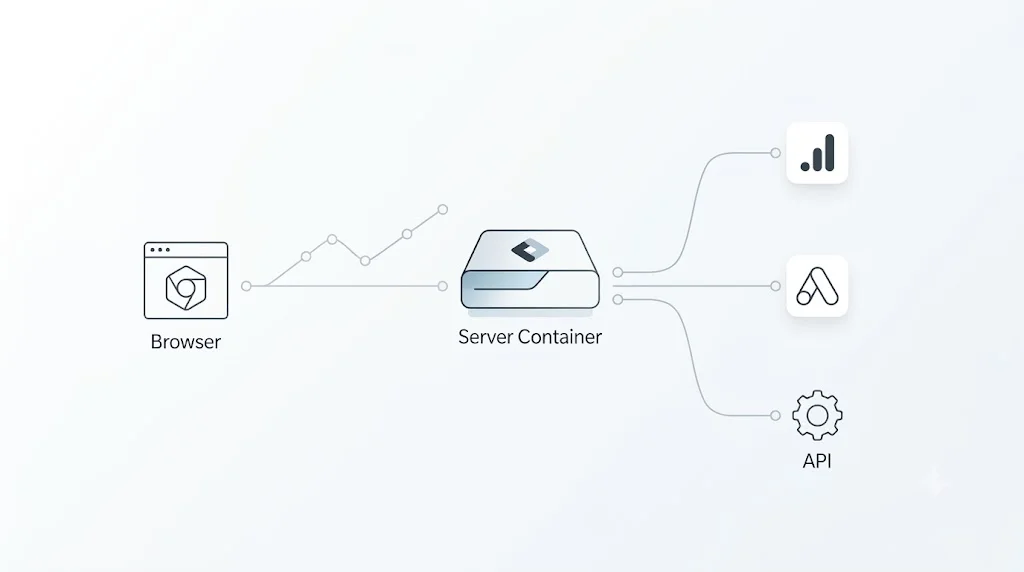
Server-side tracking pushes an intermediate stop into the data flow. Instead of sending directly to Google and Meta, the browser first sends the events to a server container running on its own subdomain, controlled by the company. Only this server then forwards the data to the respective platforms.
Google describes the principle in its official documentation: the processing of measurement data happens on a server the company controls, not in the browser, and only that company has access to the data on the server until it forwards it itself. As the operating environment, Google recommends a dedicated cloud project, typically via Cloud Run.
Three structural advantages follow from this setup:
- Own domain instead of provider domain: requests run through your own subdomain and no longer look like classic tracking calls to blockers.
- First-party context: cookies are set server-side in the first-party context and are therefore not subject to the hard 7-day or 24-hour cap on client-side script cookies.
- Control over the payload: before data leaves the house, it can be filtered, shortened, anonymized or enriched with additional information.
In practice: How to set up a self-hosted server container with Google Tag Manager and GA4 step by step is shown in the complete guide to setting up server-side tracking – including screenshots from practice.
The concrete advantages of server-side tracking
Better data quality and more captured conversions
The most immediate effect is the recovery of conversions that are lost on the client side. Reliable universal percentages should be treated with caution, because they depend heavily on the business model. For orientation, Google cites a data quality uplift of around 11 percent for its own lightweight Tag Gateway, while full server-side tagging is often cited at 15 to 20 percent in practice. Not every company reaches these values, but many do. Meta itself phrases it qualitatively: the Conversions API is less affected by ad blockers, connectivity issues and loading errors than the pixel alone, and helps lower the cost per action.
Data sovereignty and data minimization
Because the data first lands on your own server, the company decides what is passed on to third parties at all. Personal fields can be removed, IP addresses shortened, values hashed. This is not only a privacy advantage (more on that below), but also a quality advantage, because the data structure becomes clean and consistent.
Browser performance
Every tracking tag that no longer runs in the browser is JavaScript that no longer loads and blocks the page. Server-side setups shift part of this load away from the device, which benefits load times and Core Web Vitals, a ranking factor closely tied to search engine optimization.
Data enrichment
Perhaps the strongest, often underestimated lever: on the server, events can be combined with data from other systems before they go to the ad platform. A practical example: when a form is submitted, the website delivers only the email address. The server uses it to query the CRM, retrieves first name, last name and further attributes, and sends an enriched conversion to Google Ads. This improves attribution and thus the steering of the campaigns. In the same way, a purchase that initially reports only a transaction ID and amount can be enriched server-side with customer data from the shop system.
The key setups: CAPI, Enhanced Conversions, Consent Mode
Server-side tracking is not a single product, but a setup in which several building blocks interact. Three of them are central for advertising companies.
Meta Conversions API (CAPI)
The Conversions API sends web, app and offline events directly from the server to Meta. Combined with the browser pixel, a redundant, more robust data stream emerges. So that the same conversion is not counted twice, Meta deduplicates the events using a shared event_id and the event_name. This is exactly where the most common mistake in practice lies: if deduplication is not configured cleanly, it either double-counts or events are missing.
Google Enhanced Conversions
Enhanced Conversions improves the accuracy of conversion measurement in Google Ads by sending hashed first-party data such as the email address to Google using a secure one-way hashing algorithm (SHA-256). The data therefore leaves the system only in pseudonymized form. In a server-side setup, this step can be controlled centrally and consistently.
Consent Mode v2
The Consent Mode adjusts the behavior of the Google tags to the user’s
consent decision. Since version 2, in addition to the signals ad_storage and
analytics_storage, the signals ad_user_data and ad_personalization are
also mandatory. Without a correctly implemented Consent Mode, conversion import
and audiences no longer work fully in the EU. Server-side and Consent Mode are
not opposites here, but complement each other: the Consent Mode controls
whether and how data may be collected, server-side controls how it
is processed afterwards.
New from 2026: Google Tag Gateway vs. server-side GTM
A third term has recently entered the discussion. In the YouTube piece “Google Tag Gateway vs Server-side tracking” by Analytics Mania, the difference is explained in practical terms, and it is decisive for choosing the right setup.
Google Tag Gateway (GTG) is essentially a reverse proxy. The tracking code
stays in the browser, but the requests run through your own domain instead of
google-analytics.com. That is enough for some blockers to no longer recognize
them as tracking. GTG is set up in a few minutes, for example via Cloudflare,
and is virtually maintenance-free. Its limits: it works only with Google
products, does not hide the request parameters (so blockers still recognize
the tracking by the parameters), still forwards a portion of requests to Google
for compliance reasons, and offers no control over the data.
Server-side Google Tag Manager (sGTM) goes considerably further: all requests through your own domain, parameters hideable, data to multiple platforms at once (Google, Meta CAPI, TikTok, Snapchat) and full control to edit and enrich. The price is the higher effort and ongoing cost.
| Criterion | Google Tag Gateway | Server-side GTM |
|---|---|---|
| Setup effort | very low (minutes) | high (hours to days) |
| Supported platforms | Google only | Google, Meta CAPI, others |
| Hide request parameters | no | yes |
| Data control and enrichment | none | full |
| Cost | low to none | ongoing hosting |
| Typical data uplift | approx. 11 % (Google figure) | often 15–20 % |
Good to know: Tag Gateway and server-side GTM are not mutually exclusive. A pragmatic path is to start with Tag Gateway or Enhanced Conversions and expand to full server-side GTM as soon as multiple ad platforms or data enrichment come into play.
Data protection: server-side is no consent replacement
This is where the most dangerous misconception arises. Server-side tracking is occasionally sold as a way to bypass cookie consent. This is false and legally risky.
Article 5(3) of the ePrivacy Directive, implemented in Austria in Section 165 TKG 2021 (previously Section 96 TKG 2003), in Germany in the TDDDG (formerly TTDSG), requires prior informed consent for storing and reading information on the end device, in a technology-neutral way. The EDPB Guidelines 2/2023 make explicitly clear that this obligation extends beyond classic cookies to pixels, URL-based tracking, unique identifiers and server-side processing. Moving the data to the server therefore does not lift the consent requirement.
On top of this comes the question of data transfers to the USA. With the Schrems II ruling (July 2020), the CJEU struck down the Privacy Shield. The Austrian data protection authority decided in January 2022, as the first authority in Europe, that the use of Google Analytics with data transfer to the USA violates the GDPR. Since July 2023, the EU-US Data Privacy Framework has provided a new adequacy decision that transfers to certified US companies currently rely on, but whose validity is again being challenged in court.
Important: Server-side tracking is a privacy opportunity, not a loophole. The advantage lies in data minimization: because the company controls the data stream, it can shorten, anonymize or not pass on personal data at all before anything goes to a US service. But this advantage is only realized with clean consent management, correct Consent Mode v2 and a transparent privacy policy, not by circumventing them.
Disadvantages and limits
Server-side tracking is no sure-fire success. The honest counter-calculation:
- Setup complexity: container, subdomain, tags, triggers, variables and deduplication must interact correctly. Mistakes lead to worse data than before, not better.
- Ongoing cost: Google cites around 50 US dollars per instance per month as a guideline for Cloud Run, plus traffic and logging. With specialized hosts it sometimes starts from around 20 US dollars, and becomes considerably more with high traffic.
- Maintenance effort: server updates, adjustments to platform changes and monitoring are ongoing. Tag Gateway, by contrast, is largely "set and forget".
- No silver bullet: server-side replaces neither consent nor a sound tracking strategy. It makes a good setup better, not a bad one automatically good.
Who server-side tracking is worth it for
| Situation | Recommendation |
|---|---|
| Multiple ad platforms (Google + Meta + more) | Server-side GTM |
| Meaningful paid advertising budget | Server-side GTM, CAPI, Enhanced Conversions |
| Data enrichment from CRM or shop wanted | Server-side GTM |
| Only Google tools, small budget, little technical skill | Tag Gateway or Enhanced Conversions |
| Very low traffic, no ad budget | client-side with clean consent suffices for now |
The rule of thumb: the more money flows into paid advertising, the more expensive every uncaptured conversion becomes, because the platform algorithms optimize worse with incomplete data. That is exactly where the investment in server-side pays off fastest. Anyone who additionally wants to turn their tracking data into a foundation for visibility in AI search will find the connection in the guide Generative Engine Optimization.
Remember: Client-side tracking measurably loses data to ad blockers, Safari, Firefox and iOS. Server-side tracking recovers part of it, provides data control and enables enrichment, but costs effort, money and maintenance. It does not replace consent, but makes privacy-compliant work easier. The most robust solution is almost always a hybrid setup of browser pixel and server-side channel with clean deduplication.
Frequently asked questions
What is the difference between server-side and client-side tracking?
With client-side tracking, a JavaScript tag or pixel sends data directly from the user's browser to providers like Google or Meta. With server-side tracking, this data first passes through a server the company controls, and only from there is it forwarded to the platforms. Server-side is more resilient against ad blockers and browser restrictions and gives more control over the data, but it is more involved to set up.
Is server-side tracking GDPR-compliant and does it replace cookie consent?
No, server-side tracking does not replace consent. Article 5(3) of the ePrivacy Directive, implemented in Austria in Section 165 TKG 2021, requires prior informed consent for storing and reading information on the end device, regardless of whether the tracking happens in the browser or on the server. However, server-side does make data minimization easier, because personal data can be filtered or anonymized before being passed to third parties.
How many conversions are lost through client-side tracking?
There is no exact blanket figure, because the loss depends on industry, audience and devices. The drivers are ad blockers (according to GWI/DataReportal, around 29.5 percent of internet users worldwide and over 32 percent in Austria use an ad blocker at least occasionally), the 7-day and 24-hour cap on client-side cookies in Safari, and iOS App Tracking Transparency. In sum, a purely client-side setup often misses double-digit percentages of the actual conversions in the ad accounts.
What is the Meta Conversions API (CAPI)?
The Meta Conversions API sends conversion events directly from the server to Meta, instead of relying solely on the browser pixel. According to Meta, it is less affected by loading errors, connectivity issues and ad blockers than the pixel alone. When pixel and CAPI are used in parallel, Meta deduplicates identical events using the event_id and event_name so that the same conversion is only counted once.
What is Google Tag Gateway and how does it differ from server-side GTM?
Google Tag Gateway is essentially a reverse proxy: tracking requests run through your own domain instead of google-analytics.com, so some ad blockers no longer recognize them. It works only with Google products, does not hide the request parameters and offers no data control. Server-side Google Tag Manager goes further: all requests run through your own domain, parameters can be hidden, data can be sent to multiple platforms such as Meta CAPI, and edited or enriched before being forwarded.
What does server-side tracking cost?
The ongoing cost comes mainly from hosting the server container. Google gives a guideline of around 50 US dollars per instance per month for running it on Cloud Run, plus traffic and logging. With smaller setups or specialized hosting providers, operation sometimes starts from around 20 US dollars per month, and can be considerably higher with high traffic. On top of that come the one-time setup and the ongoing maintenance effort.
Do small businesses need server-side tracking too?
It is worthwhile primarily for companies that invest meaningful budget in paid advertising, since here every uncaptured conversion degrades the optimization of the algorithms and raises the cost per action. Anyone moving only small ad budgets and using Google tools exclusively can start with a lighter setup such as Google Tag Gateway or Enhanced Conversions and expand later.
Does server-side tracking make the client-side pixel obsolete?
Usually not. The most robust solution is a hybrid setup: the client-side pixel captures browser signals, the server-side channel adds the events that are lost in the browser. Deduplication ensures no conversion is counted twice. This way both paths complement each other rather than excluding one another.
Sources
- Google: Server-Side Tagging – Intro (Tag Platform)
- Google: Server-Side Tagging – Planning infrastructure & cost
- Meta for Developers: Conversions API – Overview
- Meta for Developers: Pixel & server event deduplication
- Google Ads Help: Enhanced Conversions
- Google: Consent Mode (v2) – Concept
- WebKit: Full Third-Party Cookie Blocking and More (ITP, 7-day cap)
- WebKit: Intelligent Tracking Prevention 2.2 (24-hour cap)
- Mozilla: Total Cookie Protection on by default for all users
- Google Privacy Sandbox: Next steps (third-party cookies, April 2025)
- Apple Developer: App Tracking Transparency Framework
- CJEU: Schrems II – Press release 91/20 (C-311/18)
- EUR-Lex: EU-US Data Privacy Framework – Decision (EU) 2023/1795
- noyb: Austrian DSB – EU-US data transfers via Google Analytics unlawful
- EDPB: Guidelines 2/2023 on the technical scope of Art. 5(3) ePrivacy