Conversion tracking that stays GDPR-compliant.
And still measures completely.
Dometrics builds tracking setups that respect consent and still deliver reliable conversion data: Consent Mode v2, server-side tracking on the company's own domain and a data flow the company controls itself.
- 14:02:11
page_view/espressomaschinen/siebtraeger-pro GA4AdsMeta - 14:03:40
add_to_cartPortafilter Pro · €489.00 GA4AdsMeta - 14:04:18
begin_checkoutCart · €529.00 GA4AdsMeta - 14:05:02
purchaseOrder 10482 · €529.00 · deduplicated GA4Ads cookielessMeta
Where tracking breaks today.
Almost every setup shows the same pattern: legally shaky or technically incomplete, often both. The result is ad platforms optimising on too few and wrong signals.
Tags fire before consent
Pixels and analytics scripts load before the cookie banner has been answered. This breaches § 165 of the Austrian Telecommunications Act (TKG 2021) and is one of the most common findings in audits.
Conversions disappear
Safari limits script-set cookies to seven days, ad blockers suppress pixels, and declined consent is missing entirely. Ad accounts only see part of the sales.
No control over outgoing data
Third-party scripts send IP addresses, URLs and device information straight to Google and Meta. Nobody in the company knows exactly which data leaves.
Smart Bidding optimises into a void
Bidding strategies learn from conversions. If data is missing or values are wrong, they steer budget into the wrong campaigns. The error only shows up in revenue.
Consent first. Then measure completely.
The setup draws a clean line around what is permitted and gets the most out of every permitted measurement. Every stage is documented and auditable.
- 01 · Consent
Capture consent correctly
A consent management platform with a genuine reject option, Consent Mode v2 and a log of every decision.
- 02 · Data layer
Define events unambiguously
Purchase, enquiry, appointment: every event with value, ID and source. Defined cleanly once, used identically everywhere.
- 03 · Server
Server container on the company's own domain
Server-side tagging on a company subdomain, hosted in the EU. Data is filtered before it is passed on.
- 04 · Platforms
Pass on signals selectively
GA4, Google Ads with Enhanced Conversions and the Meta Conversions API, deduplicated and only within the scope of consent.
- 05 · Control
Reconcile with shop and CRM
Ongoing monitoring: do measured conversions match real orders and enquiries?
Standard setup versus consent architecture.
Most websites run on whatever setup a plugin or theme ships with. The difference shows in legal certainty and data quality.
| Criterion | Standard setup | Consent architecture by Dometrics |
|---|---|---|
| Consent | Banner in place, some tags load anyway | Technically enforced: no tag without matching consent |
| Cookie lifetime | Gone after 7 days in Safari | First-party cookies from the company's own server, recognition stays stable |
| Ad blockers | Pixels get blocked | Measurement via the company's own subdomain, considerably more robust |
| Data leakage | Third parties receive everything the script can read | The server filters: only approved fields leave the company |
| Declined consent | Conversion missing entirely | Consent Mode v2 provides cookieless signals for modelling |
| Smart Bidding | Learns from incomplete data | Learns from complete, value-based conversions |
Legal framework, technology and what really counts.
For years, conversion tracking has been caught between two requirements that appear to contradict each other. The law demands consent before any non-essential access to the user’s device. The ad platforms demand data that is as complete as possible to steer bids sensibly. The contradiction dissolves as soon as tracking is planned as an architecture rather than a collection of scripts.
What the law in Austria requires
Two sets of rules interlock. § 165 (3) of the Austrian Telecommunications Act (Telekommunikationsgesetz, TKG 2021) governs access to the device: cookies and comparable technologies that are not technically necessary require consent [1]. The GDPR governs the subsequent processing of personal data and sets the standard for valid consent: freely given, informed, unambiguous. A pre-ticked checkbox is not enough, as the Court of Justice of the European Union (CJEU) ruled back in 2019 [2].
Then there is the question of transfers to third countries. In 2022, the Austrian data protection authority objected to a specific use of Google Analytics because data flowed to the USA without adequate safeguards [3]. Since July 2023, the EU-US Data Privacy Framework has again provided a legal basis for transfers to certified US companies [4]. It does not change the consent requirement for cookies.
Important: The European Data Protection Board interprets the scope of the consent requirement broadly. According to its guidelines, tracking pixels and URL-based methods are also covered, not only classic cookies [5]. Server-side tracking is therefore no way around consent.
Why tracking still has gaps
Even a legally clean setup loses data if it runs only in the browser. Safari limits cookies set by scripts to seven days [7]. Someone who clicks an ad on a Monday and buys on the Wednesday of the following week is a new visitor as far as the ad account is concerned. Ad blockers suppress known pixel domains completely. And without countermeasures, every declined consent is missing from the statistics altogether.
The result is ad accounts that see fewer conversions than actually happen. For reporting, that is annoying. For steering, it is expensive: Smart Bidding allocates budget according to the conversions it sees. If the purchases from one channel are systematically missing, that channel is systematically undervalued.
What server-side tracking delivers
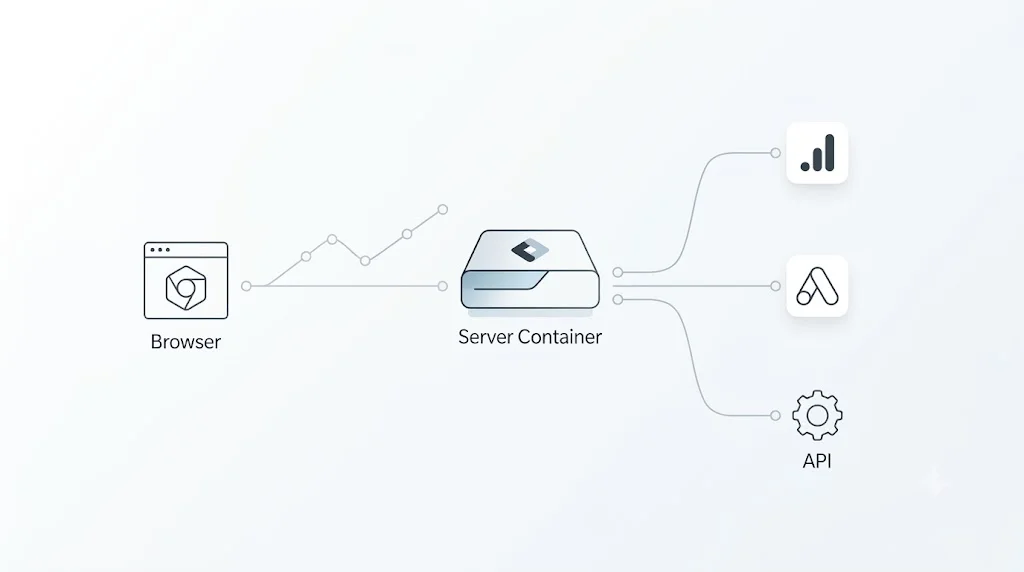
With server-side tracking, the website does not send events directly to Google or Meta but to the company’s own server container on a company subdomain [8]. This server sets first-party cookies with a stable lifetime, checks the consent status and decides which fields are passed to which platform. IP addresses can be truncated, URL parameters removed and sensitive fields discarded.
Three effects matter: measurement is more robust against browser restrictions, control over outgoing data rests with the company, and the website loads faster because fewer third-party scripts run in the browser.
Consent Mode v2: modelling instead of guessing
For visitors without consent, a gap remains that technology cannot close and should not close. Google’s Consent Mode v2 passes the consent status to Google tags. Without consent, they only send cookieless signals without identifiers, from which Google extrapolates missing conversions statistically [6]. Since March 2024, Consent Mode v2 has been a prerequisite for using personalisation and remarketing features for users in the European Economic Area.
Where data protection and data quality meet
The strongest signals arise where consent exists and the company holds its own data. Enhanced Conversions and the Meta Conversions API transmit hashed customer data, such as a buyer’s email address, so that the platform can attribute the purchase to an ad. This only works on a sound legal basis, and then it is considerably more effective than any cookie. Transmitting order values instead of mere counts also gives Smart Bidding the information it is actually meant to optimise for: revenue.
Key point: Complete data does not come from more scripts, but from fewer and better controlled ones. Consent is not an obstacle here but the boundary within which the setup gets the most out of the data.
How such a server container is set up technically is described in the guide Setting up server-side tracking. A detailed comparison of both approaches is available in Server-side vs. client-side tracking. Further solutions build on the same data foundation, such as a revenue forecast or lead scoring.
What the setup includes.
- Tracking audit: which tags fire when and which data leaves
- Configuration of the consent management platform with Consent Mode v2
- Data layer concept with unambiguous events and values
- Server-side tagging on the company's own subdomain, EU hosting
- GA4, Google Ads Enhanced Conversions and Meta Conversions API
- Deduplication of browser and server events
- Technical documentation as the basis for the privacy policy and the record of processing activities
- Monitoring with reconciliation against shop or CRM data
How the project runs
Audit
Inventory of all tags, cookies and data flows. Result: a prioritised list of legal and technical gaps.
Concept
Events, values and consent categories are defined and agreed with the people responsible for data protection.
Implementation
Consent, data layer, server container and platform connections are built and tested in a staging environment.
Control
After go-live, Dometrics compares measured conversions with real ones and adjusts until the numbers hold.
Frequently asked questions
Is conversion tracking allowed without consent?
For tracking that stores or reads information on the user's device, § 165 (3) of the Austrian Telecommunications Act (TKG 2021) generally requires consent, unless the storage is technically necessary. Advertising and analytics cookies are not necessary. Without consent, only methods that do not access the device remain, such as the cookieless signals of Consent Mode v2.
Does server-side tracking make consent unnecessary?
No. Server-side tracking changes where data is processed, not whether consent is required. The benefit is control: the company decides on its own server which data goes to which platform, and measurement is more robust against browser restrictions.
Can Google Analytics still be used in Austria?
In early 2022, the Austrian data protection authority (DSB) ruled against a specific use of Google Analytics because of data transfers to the USA. Since the adequacy decision on the EU-US Data Privacy Framework of 10 July 2023, transfers to certified US companies are possible again on that basis. Consent for setting the cookies is still required.
What is Consent Mode v2?
Consent Mode v2 is a Google interface through which the website passes the consent status to Google tags. Without consent, the tags only send cookieless signals, from which Google models missing conversions statistically. Since March 2024, Consent Mode v2 has been a prerequisite for personalised advertising in the European Economic Area.
How many conversions are lost without server-side tracking?
That depends on the consent rate, browser mix and ad blocker usage of the specific audience and cannot be put into a flat figure. Reconciling measured conversions with real orders in the shop or CRM makes the gap visible for the individual company. This reconciliation is exactly the first step of the audit.
Does Dometrics also provide legal advice?
No. Dometrics is an IT service provider and implements the technical side: consent logic, data flows and documentation. The privacy policy, record of processing activities and data processing agreements should be agreed with legal counsel or the data protection officer. The technical documentation provides the basis for this.
What does a GDPR-compliant tracking setup cost?
The effort depends on the number of platforms, the shop or CRM system and the state of the existing setup. On top come ongoing hosting costs for the server container: Google cites around 50 US dollars per instance per month for Cloud Run as a guideline, and specialised hosts start at roughly 20 US dollars. After the audit, there is a fixed price.
- [1] RIS: Telekommunikationsgesetz 2021 (Austrian Telecommunications Act), BGBl. I Nr. 190/2021 (§ 165)
- [2] CJEU, judgment of 1 October 2019, C-673/17 (Planet49): a pre-ticked checkbox is not consent
- [3] noyb: Austrian DSB: EU-US data transfers to Google Analytics illegal (2022)
- [4] EUR-Lex: Commission Implementing Decision (EU) 2023/1795, EU-US Data Privacy Framework
- [5] EDPB: Guidelines 2/2023 on the technical scope of Art. 5(3) of the ePrivacy Directive
- [6] Google: Consent Mode (v2), concepts
- [7] WebKit: Full Third-Party Cookie Blocking and More (ITP, 7-day cap)
- [8] Google: Server-side tagging, introduction