Kimi K3: Moonshot AI's 2.8 trillion parameter model challenges the AI elite
Kimi K3 is the largest announced open-weight model of all time: 2.8 trillion parameters, 1 million tokens of context, rank 1 in the Code Arena. What the model can do, what it costs, why subscriptions run through a waitlist and what it means for companies.
A good month ago, GLM 5.2 showed that open-source AI has arrived in the top tier. Now Moonshot AI raises the stakes: Kimi K3, released on July 16, 2026, is the largest announced open-weight model of all time at 2.8 trillion parameters. It debuted at rank 1 in the Frontend Code Arena, processes one million tokens of context and understands images natively. This article breaks down what is inside the model, what it can really do, where its limits are and what the development means for companies.
The essentials at a glance:
- 2.8 trillion parameters, of which only around 1.8 percent are active per token: the largest announced open-weight model of all time.
- 1 million tokens of context plus native image understanding and transparent reasoning chains.
- Rank 1 in the Frontend Code Arena, rank 3 on GDPval-AA v2 behind Claude Fable 5 Max and GPT-5.6 Sol Max, ahead of Claude Opus 4.8.
- API price: 3 US dollars input, 15 US dollars output per million tokens, cache hits at 0.30 US dollars.
- Weights announced for July 27, 2026 on Hugging Face; self-hosting requires data centre hardware.
- Victim of its own success: since July 19, new subscriptions are only available via waitlist; GPU capacity was exhausted within 48 hours.
What is Kimi K3?
Kimi K3 is the new flagship model from Moonshot AI, one of China’s leading AI labs. It is a mixture-of-experts model: of the 2.8 trillion parameters, distributed across 896 specialised expert networks, only 16 experts work per token. The model is therefore gigantic in knowledge but frugal in operation.
The key facts at a glance:
| Property | Kimi K3 |
|---|---|
| Provider | Moonshot AI (China) |
| Architecture | Mixture of experts, 2.8 trillion parameters (16 of 896 experts active) |
| Context window | 1,048,576 tokens (around 1 million) |
| Modalities | Text and native image understanding (vision) |
| Reasoning | Maximum thinking depth by default, reasoning chains transparent |
| Weights | Open weights, announced for July 27, 2026 on Hugging Face |
| API price | 3.00 $ input / 15.00 $ output per million tokens, 0.30 $ cache hits |
Three points stand out. First, the sheer size: 2.8 trillion parameters is almost three times the predecessor K2. Second, the openness: Moonshot not only publishes the weights but also exposes the model’s internal reasoning chains, which proprietary providers usually hide. Third, the timing: only weeks after GLM 5.2 from Z.ai, the next Chinese model appears at frontier level. The gap between open and closed systems is shrinking in months, not years.
Who is behind Moonshot AI?
Moonshot AI became known through the Kimi chatbot and the open K models and ranks among the best-funded AI companies in China. In its most recent funding round the company raised around 2 billion US dollars, with total funding of almost 4 billion. These resources explain how training at this scale is possible at all.
The predecessor Kimi K2 already set standards among open models in 2025. With K3, Moonshot repeats the pattern DeepSeek established in early 2025: a Chinese lab releases a model at the level of the Western elite, makes it freely available and thereby forces the entire market to rethink prices and strategies.
Benchmarks: rank 1 in frontend, rank 3 in real work
Two very different measurements show how good K3 really is.
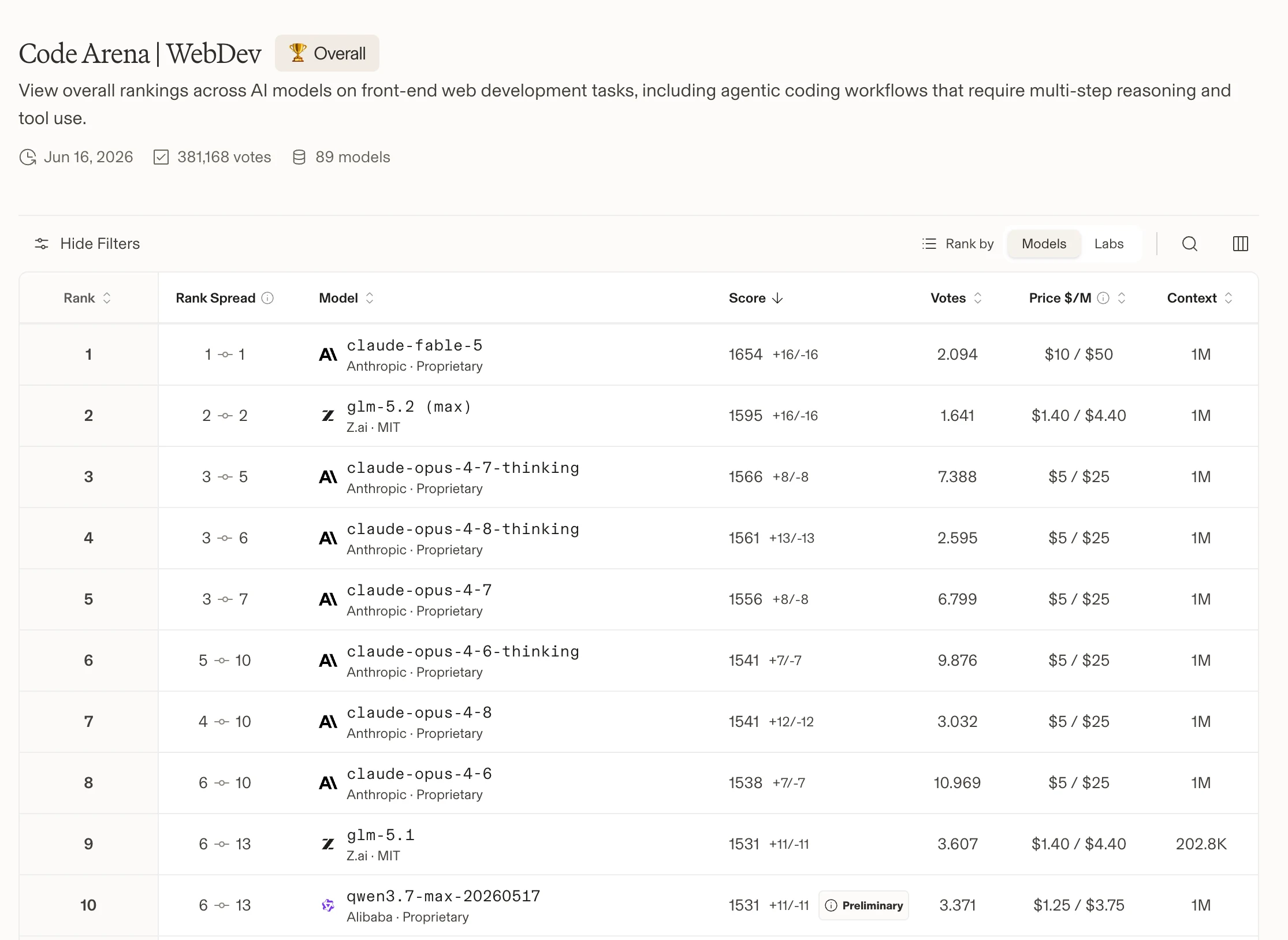
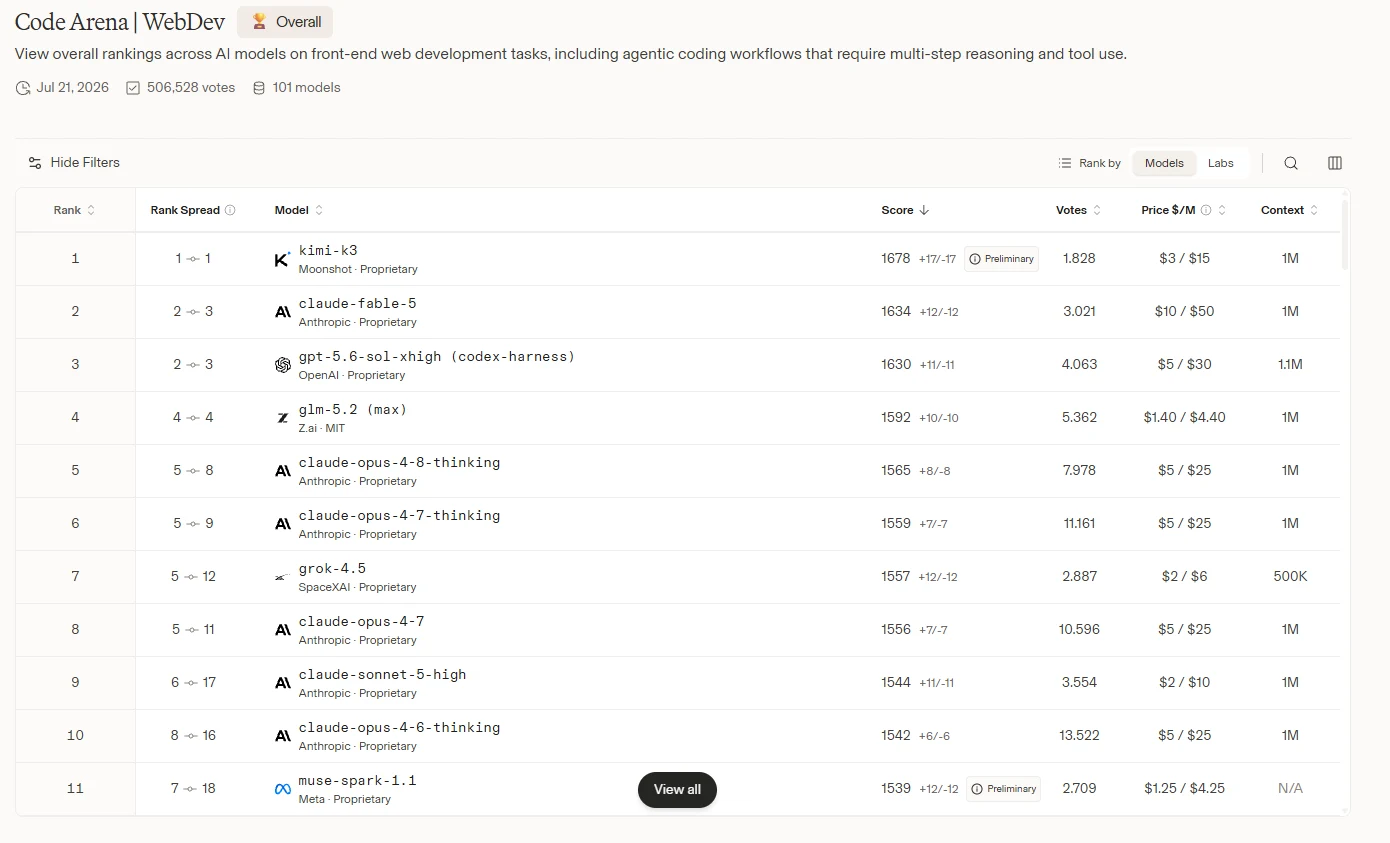
In the Code Arena (WebDev), an open leaderboard where models compete anonymously on real web development tasks, Kimi K3 debuted at rank 1, according to Tom’s Hardware a jump of 17 places over Kimi K2.6. The header image of this article shows the state as of July 21, 2026, across 101 models and more than 506,000 votes:
- Rank 1: Kimi K3 with a score of 1678, at a price of 3 / 15 US dollars per million tokens.
- Rank 2: Claude Fable 5 (Anthropic) with 1634, priced at 10 / 50 US dollars.
- Rank 3: GPT-5.6 Sol xhigh (OpenAI) with 1630.
- Rank 4: GLM 5.2 max (Z.ai) with 1592, which held rank 2 as the best open model just a month ago.
The pace of these shifts is remarkable: within five weeks, the top of the leaderboard has reshuffled twice, both times through a model from China.
On GDPval-AA v2, a benchmark measuring real work tasks from 44 occupations and 9 industries, K3 reaches 1,687 points:
- Rank 1: Claude Fable 5 Max (Anthropic, proprietary) with 1,815 points.
- Rank 2: GPT-5.6 Sol Max (OpenAI, proprietary) with 1,747 points.
- Rank 3: Kimi K3 with 1,687 points, as an open model.
- Behind it: Claude Opus 4.8 with 1,600 points, until now widely regarded as the benchmark for production use.
The pattern is clear: the absolute top remains proprietary (for now), but K3 overtakes established workhorses such as Opus 4.8 and GPT-5.5 in coding and agent benchmarks. The model is conspicuously strong wherever tasks run long: in migration projects spanning hours, in spreadsheet benchmarks for knowledge work and in the Browse Comp benchmark for controlling real computer interfaces.
Good to know: In tests measuring hallucination tendency, K3 achieves top scores. The model recognises knowledge gaps comparatively reliably and then answers with „I don’t know” instead of inventing plausible-sounding facts. For enterprise use, this property is often more important than a few extra benchmark points.
The architecture: why 2.8 trillion parameters remain affordable
Kimi K3 is not simply a larger model but a fundamentally more efficiently built one. Four innovations interlock. Anyone only interested in the business perspective can skip this section; for understanding the cost structure it is worth reading.
Extreme sparsity: 16 of 896 experts
The network is divided into 896 highly specialised experts, of which exactly 16 are active per token, including two permanently active shared experts. The activation rate of around 1.8 percent is even lower than in the smaller predecessor K2 (2 percent). Simplified: K3 has the knowledge of a 2.8 trillion model but computes each request with only a fraction of it.
Kimi Delta Attention: the lever for 1 million tokens
Classic transformers scale quadratically with context length, making long inputs prohibitively expensive. Kimi Delta Attention (KDA) uses principles of linear attention and controls at channel level which information stays in memory and which fades at what pace. In the network, KDA is interwoven with a global attention at a 3:1 ratio. According to Moonshot, this technique keeps decoding throughput six times higher than conventional approaches.
Stable Latent MoE and quantile balancing
Distributing almost 900 experts across many GPUs normally creates a communication bottleneck. K3 compresses the token representation before sending it through the expert network and decides expert selection via quantile balancing: experts are rated relative to one another instead of against rigid thresholds. This stabilises training and distributes the load more evenly.
Attention residuals: information flow through depth
The deeper a network, the more the original inputs get diluted. K3 allows deep layers targeted access to grouped earlier layers. This keeps information from the beginning of a long document available even in the final processing steps, which is decisive with one million tokens of context.
What Kimi K3 can do in practice
Benchmarks are one thing. More interesting are the capabilities the model has demonstrated in practice.
Frontend development with vision in the loop
Because K3 can write code and understand images natively, it checks its own results visually: it generates an interface, looks at the rendering like a developer looks at the browser and corrects iteratively. Demonstrations include complex dashboards, marketing pages with animations and faithful recreations of demanding interface styles.
Agents for long tasks
K3 independently breaks large tasks into workflows, launches sub-agents for subtasks, verifies their results and works through to-do lists dynamically. Exactly this capability makes the difference between a chat model and a system that survives multi-hour projects such as codebase migrations.
Unusual special disciplines
- 3D and games: Simple prompts produce functional 3D browser games including game logic, textures and sound effects.
- Hardware-level programming: Moonshot uses K3 internally to optimise GPU kernels; in tests the model developed a compact GPU compiler from scratch.
- Security audits: The model can launch hundreds of verification agents in parallel to check cloud infrastructures for vulnerabilities.
- Video editing: Automated cuts including clip selection, motion-matched transitions and audio processing have been successfully demonstrated.
Important: Nobody should ignore the offensive flip side of the audit capabilities. With open weights, the guardrails that proprietary providers enforce server-side disappear. The same capabilities that help security teams can be used by attackers for automation. Companies should therefore govern the use of open models just as rigorously as that of proprietary systems.
Costs: more expensive than GLM 5.2, cheaper than the Opus class
In API pricing, Kimi K3 positions itself in the middle of the frontier segment:
| Model | Licence | Input per M tokens | Output per M tokens | Context |
|---|---|---|---|---|
| Claude Fable 5 (Anthropic) | proprietary | 10 $ | 50 $ | 1M |
| Claude Opus 4.8 (Anthropic) | proprietary | 5 $ | 25 $ | 1M |
| Kimi K3 (Moonshot AI) | Open weights (announced) | 3 $ | 15 $ | 1M |
| GLM 5.2 max (Z.ai) | MIT (open weights) | 1.40 $ | 4.40 $ | 1M |
Three details put the nominal price into perspective. First, it applies flat across the entire context window, while some providers charge extra for long contexts. Second, cache hits cost only 0.30 US dollars per million tokens, which saves massively with recurring long contexts (such as a codebase that stays constant across many requests). Third, K3 works token-efficiently: according to Moonshot it needs around 21 percent fewer tokens than K2 to reach the correct solution and rarely falls into expensive error loops on complex tasks.
For practice this means: for short standard tasks, GLM 5.2 remains the cheaper choice. For long, agentic tasks with lots of reused context, K3 can be more economical despite higher list prices, because fewer attempts are needed.
Subscription via waitlist only: success overruns the servers
Anyone wanting to use Kimi K3 on a subscription today ends up in the queue. Just 48 hours after launch, on July 19, 2026, Moonshot stopped accepting new consumer subscriptions: demand had nearly exhausted the company’s available GPU capacity. Existing users keep their access, new spots are released in batches, and the weights release announced for July 27 should ease the pressure further, because third-party providers can then host the model themselves.
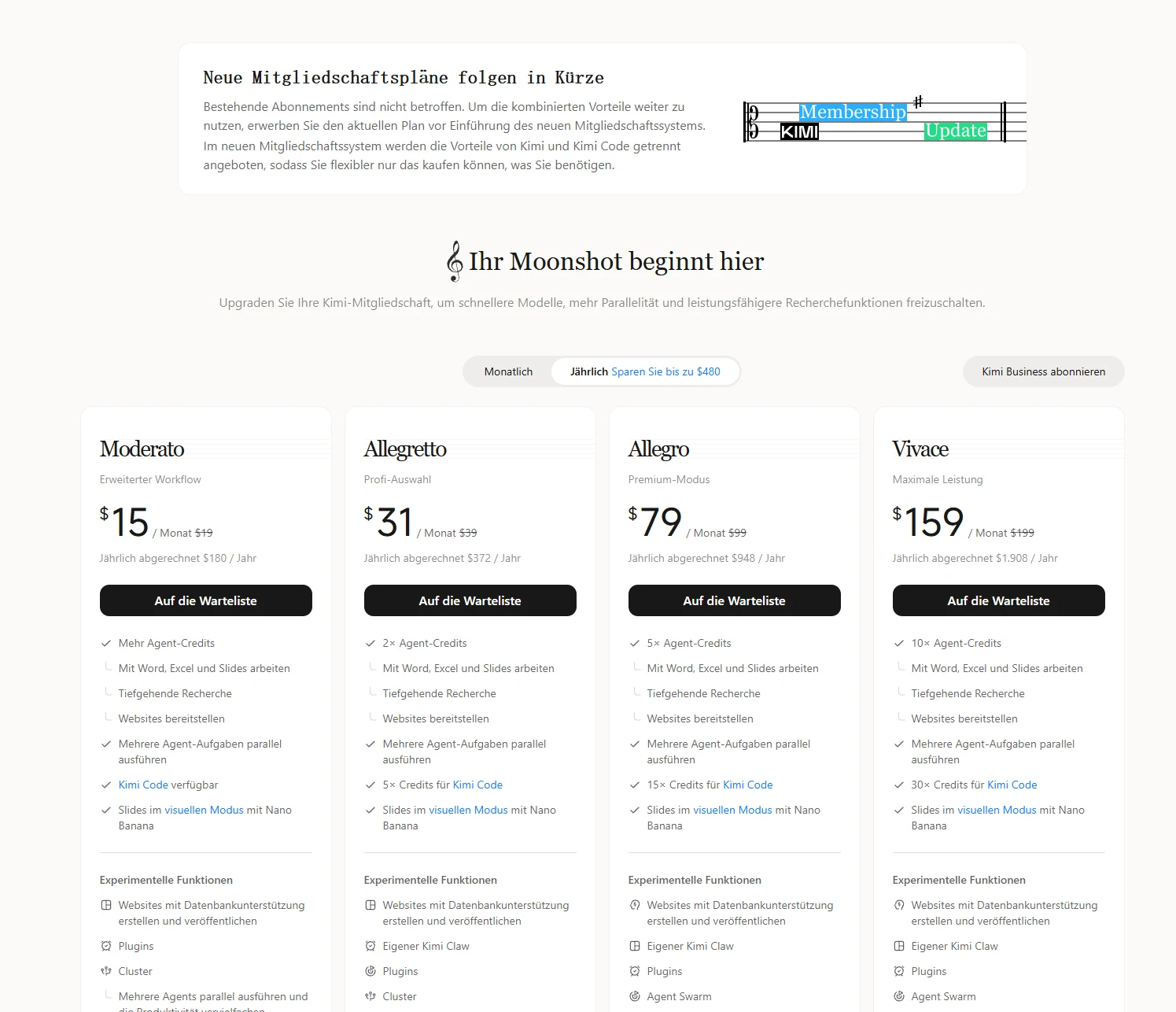
The price structure itself has four tiers: Moderato (15 US dollars), Allegretto (31), Allegro (79) and Vivace (159), each per month on annual billing, scaled by agent credits, parallelism and Kimi Code quotas. None of it can currently be booked directly; every plan ends on the same button: „Join the waitlist”.
The bottleneck is not a Moonshot problem but a symptom of a market hitting its physical limits in 2026:
- Exploding demand: according to investor Tomasz Tunguz, processed token volume rose from around 6 million tokens per minute in October 2025 to roughly 15 billion in March 2026.
- Sold-out hardware: rental prices for Nvidia's Blackwell GPUs reached 4.08 US dollars per hour, up 48 percent in 60 days; on-demand capacity is effectively sold out.
- The big players are affected too: OpenAI's CFO publicly stated the company is passing on business opportunities simply because it lacks compute.
- New providers fill the gap: even SpaceX now rents out computing power. According to Fortune, Anthropic uses the entire Colossus 1 cluster (over 300 megawatts, more than 220,000 Nvidia GPUs) for around 1.25 billion US dollars per month through May 2029, and the startup Reflection AI pays SpaceX around 150 million US dollars monthly starting July 2026.
Good to know: A waitlist shortly after launch is not a new phenomenon. Back in late 2023, OpenAI paused new ChatGPT Plus signups for weeks because demand exceeded capacity. What is new is the scale: in 2026, computing power is the scarcest resource of the entire industry, and anyone planning AI products should factor in compute availability as a risk of its own.
Self-hosting: possible, but not for the server room in the basement
Open weights do not mean every company can run the model. The numbers speak for themselves:
- Memory footprint: around 2.8 terabytes in FP8 precision, still 1.4 terabytes compressed to FP4, for the weights alone.
- Recommended hardware: configurations starting at 64 H100-class accelerators; acquisition costs in the region of 2.6 million US dollars.
- No consumer operation: K3 cannot run on single GPUs or Apple Silicon machines.
- Clever compromise: the weights are stored space-efficiently in FP4 while runtime computation happens in the more precise FP8 format.
Realistically, most companies will therefore use the model via the API, via inference providers hosting the model, or via dedicated cloud instances. The strategic value of the open weights remains nonetheless: no single provider can switch the model off, reprice it or change it. How quickly that can happen was shown by the brief offline period of Claude Fable 5, covered in the article on Claude Fable 5.
The honest weaknesses
A reliable assessment includes the rough edges, and K3 has several:
- Perceived slowness: at around 20 tokens per second in output, K3 is noticeably slower than many competitors. Anyone working interactively will feel it.
- Over-proactivity: the model tends to execute actions unprompted or to launch more sub-agents than necessary.
- Reasoning overhead: because K3 works with maximum thinking depth by default, it occasionally ponders trivialities and burns time and tokens doing so.
- Workflow communication: in complex multi-agent tasks the model sometimes reports completion to its own sub-agent instead of the user, requiring a follow-up prompt.
- Weights not yet online: at launch, K3 was only usable via API and app; the weights release is announced for July 27, 2026. Until then, „open weight" is a promise, not a fact.
The market: the next DeepSeek moment
The strategic significance of K3 extends beyond the model itself. For the second time within a few weeks, a Chinese lab shows that frontier performance is not exclusive to the Western market leaders. For OpenAI, Anthropic and Google this means price pressure from below combined with innovation pressure from the side.
A paradox stands out here: K3 was trimmed for efficiency under the conditions of US export restrictions. If the same model runs on modern Western cloud infrastructure, it is likely to work even faster and cheaper than in China itself. The efficiency innovations born of necessity ultimately benefit all operators.
What this means for companies
For business practice, Kimi K3 confirms a development that has been emerging for months: the language model is becoming interchangeable, the choice is growing, prices are falling. The consequences:
- Model choice per task instead of blanket provider loyalty: cheap open models for volume work, K3 for long agentic tasks, proprietary flagship models for the hardest edge cases.
- Orchestration as the lasting value: prompt structures, context management and agent logic outlive every model change. Those who build cleanly here swap the inference engine with a few lines of configuration.
- Visibility in AI answers is becoming more important: the more capable models prepare purchase decisions, the more decisive it becomes whether your own brand appears in their answers.
Exactly this trade-off between performance, cost and visibility is part of Dometrics’ work, for instance when building content that gets cited in AI answers. What that looks like in concrete terms is described in the service GEO & AI Search and in the guide Generative Engine Optimization.
Remember: Kimi K3 once again pushes the boundary of what open models can do: rank 1 in frontend, rank 3 in real knowledge work, at a third of the Opus price. The question for companies is not which model is the best, but which model delivers the most economical result for which task.
TL;DR
- Frontier is no longer exclusive: after GLM 5.2, Kimi K3 is the second proof within weeks that open models reach the level of the Western elite.
- Strengths: long agentic tasks, frontend development with visual self-checking and honest answers instead of hallucinations. Rank 1 in the Frontend Code Arena, rank 3 on GDPval-AA v2, ahead of Claude Opus 4.8.
- Price: around a third of the Opus class (3 $ / 15 $ per million tokens), cache hits at 0.30 $ make long, recurring contexts cheap. For short volume tasks, GLM 5.2 remains the cheaper choice.
- Weaknesses are real: around 20 tokens per second output, over-proactivity in agent tasks, subscriptions currently only via waitlist, and the weights are only announced for July 27, 2026.
- Consequence for companies: choose the model per task instead of provider loyalty, build orchestration as the lasting value and strengthen your own visibility where AI models will be answering questions.
Frequently asked questions
What is Kimi K3?
Kimi K3 is the current flagship model of the Chinese AI company Moonshot AI, released on July 16, 2026. It is a mixture-of-experts model with 2.8 trillion parameters, a context window of one million tokens and native image understanding. Moonshot has announced the release of the full model weights, which would make K3 the largest open-weight model of all time.
How large is Kimi K3?
Kimi K3 comprises 2.8 trillion parameters, distributed across 896 specialised expert networks. Only 16 of these experts are active per token, roughly 1.8 percent of the model. This extremely sparse activation is why the model remains economical to run despite its size.
What does Kimi K3 cost?
Via API, Kimi K3 costs 3.00 US dollars per million input tokens and 15.00 US dollars per million output tokens; cache hits are priced at 0.30 US dollars. The price applies flat across the entire context window of one million tokens. That places K3 well below Opus-class models but above budget open-weight alternatives such as GLM 5.2.
Why is the Kimi K3 subscription only available via waitlist?
Moonshot AI paused new subscriptions on July 19, 2026, just 48 hours after launch, because demand had nearly exhausted the available GPU capacity. Existing users keep their access, new spots are released in batches. The bottleneck reflects the industry-wide compute shortage that also affects Western providers such as OpenAI and Anthropic in 2026.
What context window does Kimi K3 have?
Kimi K3 processes up to 1,048,576 tokens of context, roughly one million. That is enough for entire codebases, extensive document collections or hours of transcripts in a single prompt. This is made possible by Kimi Delta Attention, which drastically reduces the computational cost of long contexts.
Is Kimi K3 open source?
Moonshot AI has announced the release of the full model weights on Hugging Face for July 27, 2026. At launch on July 16, the model was initially available only via API and the Kimi app. Once the weights are online, K3 will be by far the largest freely available model.
How does Kimi K3 compare to Claude Fable 5 and GPT-5.6?
On the GDPval-AA v2 benchmark for real work tasks, Kimi K3 scores 1,687 points, placing third behind Claude Fable 5 Max (1,815) and GPT-5.6 Sol Max (1,747) but ahead of Claude Opus 4.8 (1,600). In the Frontend Code Arena, K3 even debuted at rank 1, above Claude Fable 5.
Can you self-host Kimi K3?
In theory yes, in practice only with data centre infrastructure. The weights occupy around 2.8 terabytes in FP8 or 1.4 terabytes in FP4. Moonshot recommends configurations starting at 64 H100-class accelerators. The model cannot run on consumer hardware such as single GPUs or Apple Silicon machines.
Who is behind Moonshot AI?
Moonshot AI is a Chinese AI company known for the Kimi chatbot and the open K models. In its most recent funding round the company raised around 2 billion US dollars, with total funding of almost 4 billion. With K2, Moonshot already delivered one of the strongest open models in 2025.
What are the weaknesses of Kimi K3?
The model is comparatively slow in output at around 20 tokens per second, tends towards over-proactivity in agent tasks and occasionally thinks too long about trivial details, which costs time and tokens. In addition, open weights remove the guardrails enforced by proprietary providers, which raises security questions.
What does Kimi K3 mean for companies?
K3 intensifies the price and performance pressure on proprietary providers and expands the choice of frontier models with open weights. For companies, it confirms the strategy of choosing models per task: open models for volume work, proprietary flagship models for the hardest edge cases. The language model is becoming interchangeable; the lasting value lies in the orchestration.
Sources
- VentureBeat: Moonshot AI releases Kimi K3, the largest open-source model ever
- CNBC: Moonshot AI unveils Kimi K3 that rivals OpenAI, Anthropic
- Tom's Hardware: 2.8-trillion-parameter Kimi K3 beats Claude Fable 5 in Frontend Code Arena
- SCMP: Kimi K3 developer suspends new subscriptions amid compute constraints
- Fortune: SpaceX is quietly building an AI compute business
- Tomasz Tunguz: The Beginning of Scarcity in AI
- OpenRouter: Kimi K3, API Pricing & Benchmarks
- Simon Willison: Kimi K3, and what we can still learn from the pelican benchmark
- Moonshot AI on Hugging Face