GLM 5.2 by Z.ai: Open-Source AI Reaches the Top Tier
GLM 5.2 by Z.ai is an open-weight model under the MIT license with a one million token context that ranks ahead of every Opus model in the Code Arena, at a fraction of the cost. What it can do, what it costs and what it means for businesses.

For a long time, open-source AI has been treated as the cheaper but weaker alternative to the large, closed models. GLM 5.2 by Z.ai overturns that assumption. The model is released under the permissive MIT license, processes one million tokens of context and ranks ahead of every Claude Opus model in the Code Arena for web development, at a fraction of their price. This article explains what GLM 5.2 can actually do, who is behind Z.ai, and what the development means for businesses.
What is GLM 5.2?
GLM 5.2 is the current flagship model of the Chinese provider Z.ai. It is a large Mixture-of-Experts model: of a total size in the range of around 750 billion parameters, only about 40 billion are active per token. This architecture delivers the performance of a very large model at significantly lower compute cost per request.
The key facts at a glance:
| Property | GLM 5.2 (max) |
|---|---|
| Provider | Z.ai (formerly Zhipu AI) |
| Architecture | Mixture-of-Experts, around 750B parameters (approx. 40B active) |
| Context window | 1,000,000 tokens (output up to approx. 131,000) |
| License | MIT (open weights, freely available on Hugging Face) |
| Type | Reasoning model with extended thinking, text |
| API price | around 1.40 $ input / 4.40 $ output per million tokens |
The decisive factor is the combination of three things: a context window on par with the most expensive proprietary models, freely available weights, and a price far below them. This exact combination shifts the economics of automating knowledge work.
Who is behind Z.ai?
Z.ai, known as Zhipu AI until 2025, was founded in 2019 as a spin-off from the renowned Tsinghua University in Beijing. The company develops the GLM model family, short for General Language Model, whose foundations were published in a 2021 research paper.
Z.ai is among China’s leading AI labs and pursues a consistent open-weight strategy: even the predecessors in the GLM line were released under open licenses. In January 2026 the company went public in Hong Kong, raising around 558 million US dollars, a signal that this strategy is meant seriously in commercial terms as well.
The leaderboard: 2nd place, ahead of every Opus model
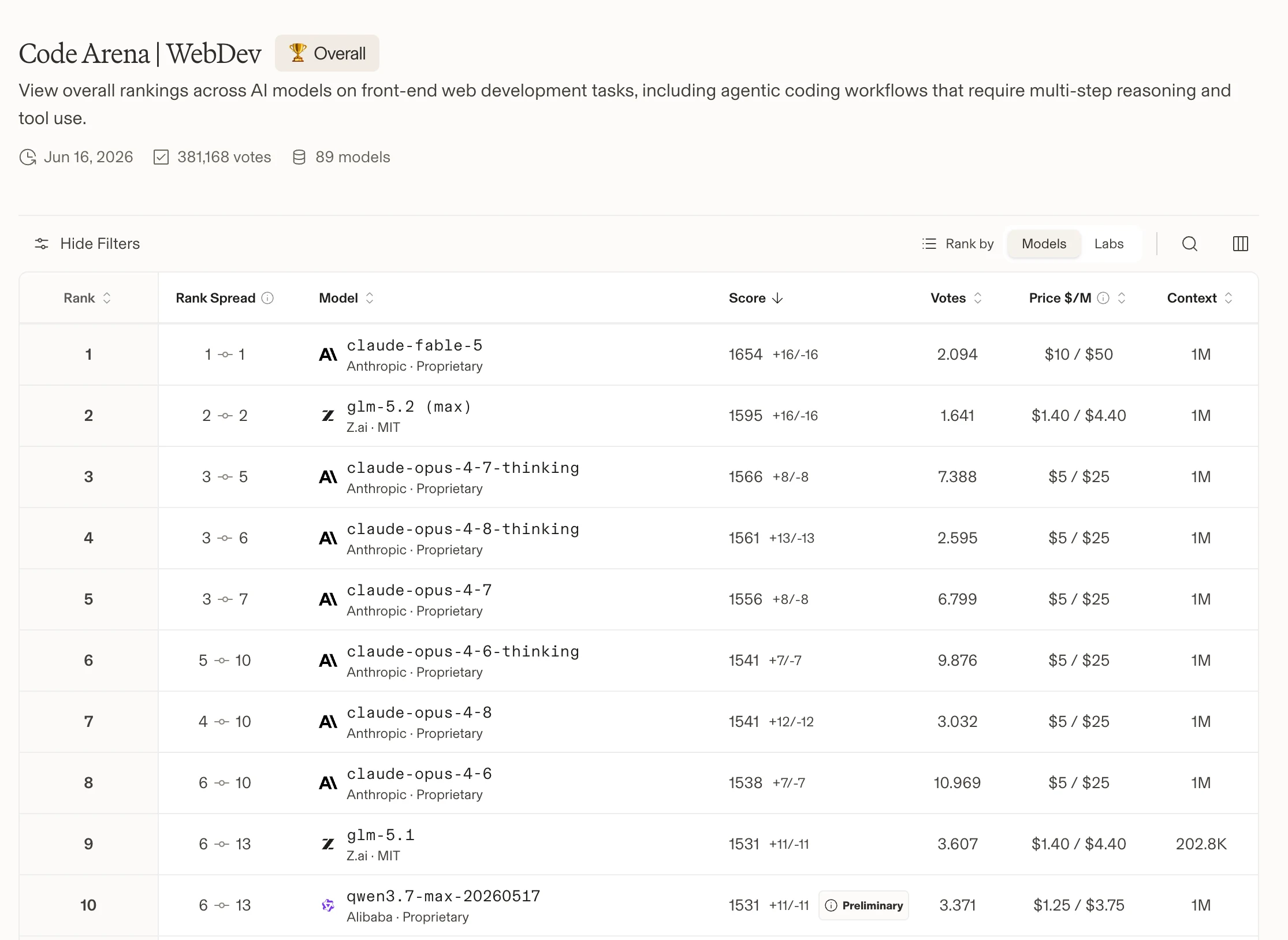
How good GLM 5.2 really is becomes clear from a look at the Code Arena for web development, an open leaderboard in which AI models compete anonymously on real frontend and coding tasks and are rated by users. The header image of this article shows the state as of June 16, 2026.
Visible there is the top of the leaderboard across around 89 models and more than 381,000 votes:
- Rank 1: Claude Fable 5 (Anthropic, proprietary) with a score of 1654.
- Rank 2: GLM 5.2 (max) by Z.ai with a score of 1595, listed as open source under the MIT license, priced at 1.40 / 4.40 US dollars, context 1M.
- Ranks 3 to 8: exclusively Claude Opus models (4.7 and 4.8, each with and without thinking) between scores of 1538 and 1566.
- Rank 9: GLM 5.1, the predecessor, with a score of 1531 and a context window of 202,800 tokens, which underlines the jump to one million in GLM 5.2.
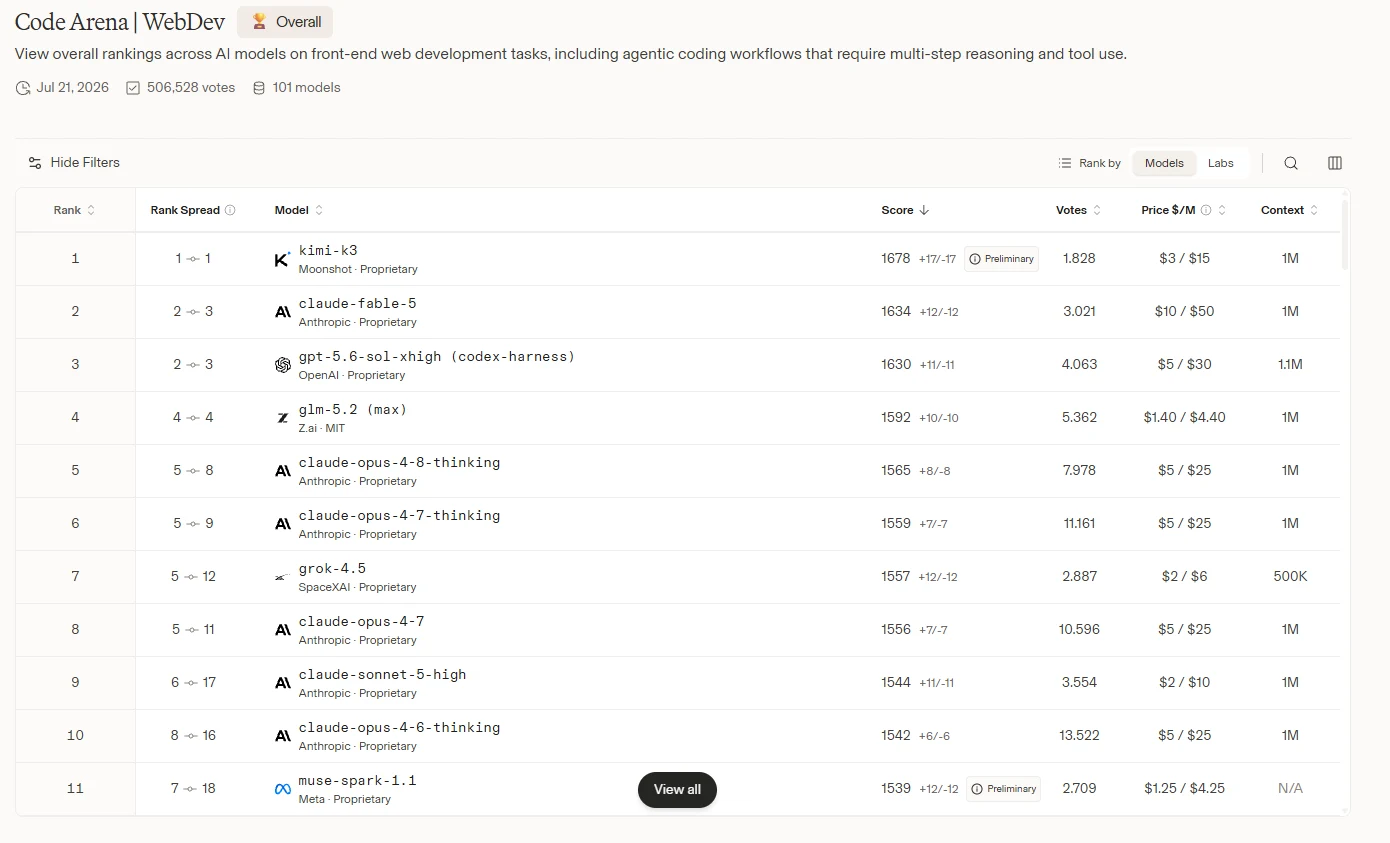
What stands out is the position: the only model ahead of GLM 5.2 is Claude Fable 5, Anthropic’s most expensive flagship model. All the Opus models, until now the benchmark, sit behind it. An open model that anyone can download freely thus beats a whole series of proprietary systems in this discipline. How quickly this development continues is shown by Kimi K3 from Moonshot AI: just one month later, the next open model debuted at rank 1 of the same leaderboard.
The efficiency argument: top performance at a fraction of the price
In real workflows, companies often pay far more for compute than is technologically necessary. A direct price comparison makes the gap visible:
| Model | License | Input per million tokens | Output per million tokens | Context |
|---|---|---|---|---|
| Claude Fable 5 (Anthropic) | proprietary | 10 $ | 50 $ | 1M |
| Claude Opus 4.8 (Anthropic) | proprietary | 5 $ | 25 $ | 1M |
| GLM 5.2 max (Z.ai) | MIT (open weights) | 1.40 $ | 4.40 $ | 1M |
On output, GLM 5.2 is therefore around five times cheaper than an Opus-class model and roughly eleven times cheaper than Claude Fable 5. According to VentureBeat, the model beats GPT-5.5 across several long-horizon coding benchmarks at roughly one sixth of the cost. On the Artificial Analysis Intelligence Index, GLM 5.2 scores 51, the top spot in its class and well above the average of comparable models of around 24.
Worth knowing: In data-intensive processes, such as analyzing large codebases, automated UI prototypes or multi-step data research, the price difference adds up quickly. Precisely where many output tokens are generated, a switch to an efficient open-weight model pays off especially fast.
Where open source dominates, and where proprietary stays essential
Choosing an AI architecture is no longer a binary question. It calls for segmentation by the nature of the task. In practice, a simple rule of thumb has proven itself at Dometrics:
- The majority via open source. Standardized text transformations, structured data extraction, code-based work and agentic research over iterative verification loops can be handled fully and cost-effectively with a model like GLM 5.2.
- The exception for high reasoning. Proprietary frontier models keep their place for extremely deep logical edge cases, such as fine-grained error analysis in complex corner cases or strategic synthesis at the highest level of abstraction.
The economic lever lies in the deliberate mix: the cheap, open model for the volume work and the expensive frontier model as a selective escalation tier.
Strategic resilience: independence from individual providers
Beyond cost, a second argument moves into focus: digital sovereignty. Companies whose core processes are exclusively tied to a single provider’s API carry a real risk. Changed terms of use, price jumps or the sudden removal of model features can paralyze business-critical workflows overnight. How quickly a model can disappear was recently shown by the brief outage of Claude Fable 5, which we examined in our article on Claude Fable 5.
Open weights shift control back to the company. The model can be run on your own or rented infrastructure, adapted and versioned, independent of a single provider’s roadmap.
Our take: Models of this size are too large for most local workstations. In practice, a hybrid path is therefore emerging: dedicated, specialized cloud infrastructure that hosts the open model exclusively. This combines data security and administrative control with moderate infrastructure costs, without dependence on a closed provider.
The real foundation: orchestration, not the model
The most important strategic insight behind this development: the language model becomes interchangeable. The lasting value lies in the orchestration around it, that is, prompt structure, context management and agent logic. Modern agent systems therefore decouple the execution framework from the inference engine.
Technically, this works through the principle of engine substitution: the framework that manages tools, context and logic stays unchanged. Only the request infrastructure is redirected to a compatible endpoint hosting the open model. In practice, a few environment variables are often enough:
# Endpoint serving the open-weight model (OpenAI-compatible)
export OPENAI_BASE_URL="https://<your-inference-gateway>/v1"
export OPENAI_API_KEY="<your-api-key>"

# Model ID of the hosted model
export MODEL="glm-5.2"
Referencing the key via an environment variable instead of hardcoding it keeps credentials out of configuration files. In agency environments, this can be controlled per project directory: a project with its own configuration routes to the cost-effective open-weight model, while another without configuration stays on the proprietary default. Changing the working directory then automatically changes the infrastructure and cost structure used, without touching any global system settings.
What this means for businesses
The real effect of GLM 5.2 is not a single benchmark, but the shift in economics. Tasks whose automation previously failed on token cost suddenly become viable. This applies precisely to data-intensive processes, from content production through data analysis to visibility in AI answers.
What remains decisive is choosing the model per task rather than a blanket “always the best model”. This very trade-off between performance and cost is part of the work at Dometrics, for example when building AI-supported content for visibility in AI answers. What that looks like in concrete terms is in the service GEO & AI Search and the guide Generative Engine Optimization.
Remember: The question is no longer “open source or proprietary”, but “which model for which task”. Those who run a dual strategy, an open model like GLM 5.2 as a cost-effective workhorse and a proprietary frontier model as a selective escalation tier, get the maximum out of every euro spent.
Conclusion
GLM 5.2 by Z.ai marks the point at which open-source AI breaks into the absolute top tier. A model with one million tokens of context, freely available weights under the MIT license and a place ahead of every Opus model in the Code Arena, at a fraction of their price, was unthinkable until recently. For businesses, this means one thing above all: more room to maneuver. More tasks become economically automatable, and dependence on a single provider declines. The language model becomes an interchangeable component. The difference is made by how well the orchestration around it is built.
Frequently asked questions
What is GLM 5.2 by Z.ai?
GLM 5.2 is a large open-weight language model from the Chinese provider Z.ai (formerly Zhipu AI). It is a Mixture-of-Experts model in the range of around 750 billion parameters, of which roughly 40 billion are active per token, with a context window of one million tokens. The weights are available under the permissive MIT license on Hugging Face.
How much does GLM 5.2 cost?
Via API, GLM 5.2 costs roughly 1.40 US dollars per million input tokens and 4.40 US dollars per million output tokens. For comparison: Opus-class models sit at around 5 and 25 US dollars. On output, GLM 5.2 is therefore about five times cheaper. Because the weights are open, it can alternatively be self-hosted, in which case you only pay for compute.
Is GLM 5.2 really open source?
The model weights are freely available for download under the MIT license on Hugging Face. This allows companies to download, adapt, fine-tune and run the model on their own or rented infrastructure. That is the decisive difference from purely proprietary API-only models.
How does GLM 5.2 compare to Claude Opus and GPT-5.5?
In the Code Arena for web development, GLM 5.2 (max) ranks 2nd with a score of 1595, ahead of every Claude Opus model and only behind Claude Fable 5 (1654). On the Artificial Analysis Intelligence Index it scores 51, the top value in its class. According to VentureBeat, it beats GPT-5.5 across several long-horizon coding benchmarks at roughly one sixth of the cost.
What context window does GLM 5.2 have?
GLM 5.2 processes up to one million tokens of context, with an output of up to around 131,000 tokens. Its predecessor GLM 5.1 was still at around 200,000 tokens. The large context window is the lever for working on entire codebases, long document collections and multi-step research.
Who is behind Z.ai?
Z.ai, known as Zhipu AI until 2025, is an AI company spun out of Tsinghua University in 2019 and based in Beijing. It develops the GLM (General Language Model) family. In January 2026 the company went public in Hong Kong, raising around 558 million US dollars.
What tasks is GLM 5.2 suited for?
For the bulk of standard knowledge work: text transformations, structured data extraction, code-based tasks and agentic research can be handled cost-effectively with GLM 5.2. For extremely deep logical edge cases, proprietary frontier models keep their place. The economically sensible strategy is a deliberate mix of both.