Claude Fable 5: Anthropic's New Flagship Model in a Hands-On Test
Claude Fable 5 tops the coding benchmarks but costs twice as much as Opus 4.8. What the model can do, why it briefly went offline, and how it performs in agentic coding.


Anthropic has introduced Claude Fable 5, the first model of its new Claude 5 generation, and it immediately tops several coding benchmarks. At the same time it costs twice as much as the previous flagship Opus 4.8, and shortly after launch it was suddenly unavailable. Dometrics tested the model extensively, with a focus on agentic coding. This article sorts out what Fable 5 can really do, where it pays off, and where the price becomes a problem.
What is Claude Fable 5?
Claude Fable 5 is the first model in the Claude 5 family and introduces a new performance tier that Anthropic calls the Mythos class. This tier sits above Claude Opus, which previously marked the top. Anthropic positions Fable 5 as its most intelligent generally available model.
A notable detail is the split into two variants that share the same underlying model:
- Claude Fable 5 is the generally available version with additional safety measures for sensitive areas such as cybersecurity and biology.
- Claude Mythos 5 is the same model without those additional measures, available only to approved organizations.
Technically, Fable 5 offers a context window of one million tokens and a knowledge cutoff of January 2026. The large context window is exactly the lever that makes the model interesting for working across entire codebases and long document collections.
Benchmarks: where Fable 5 pulls ahead
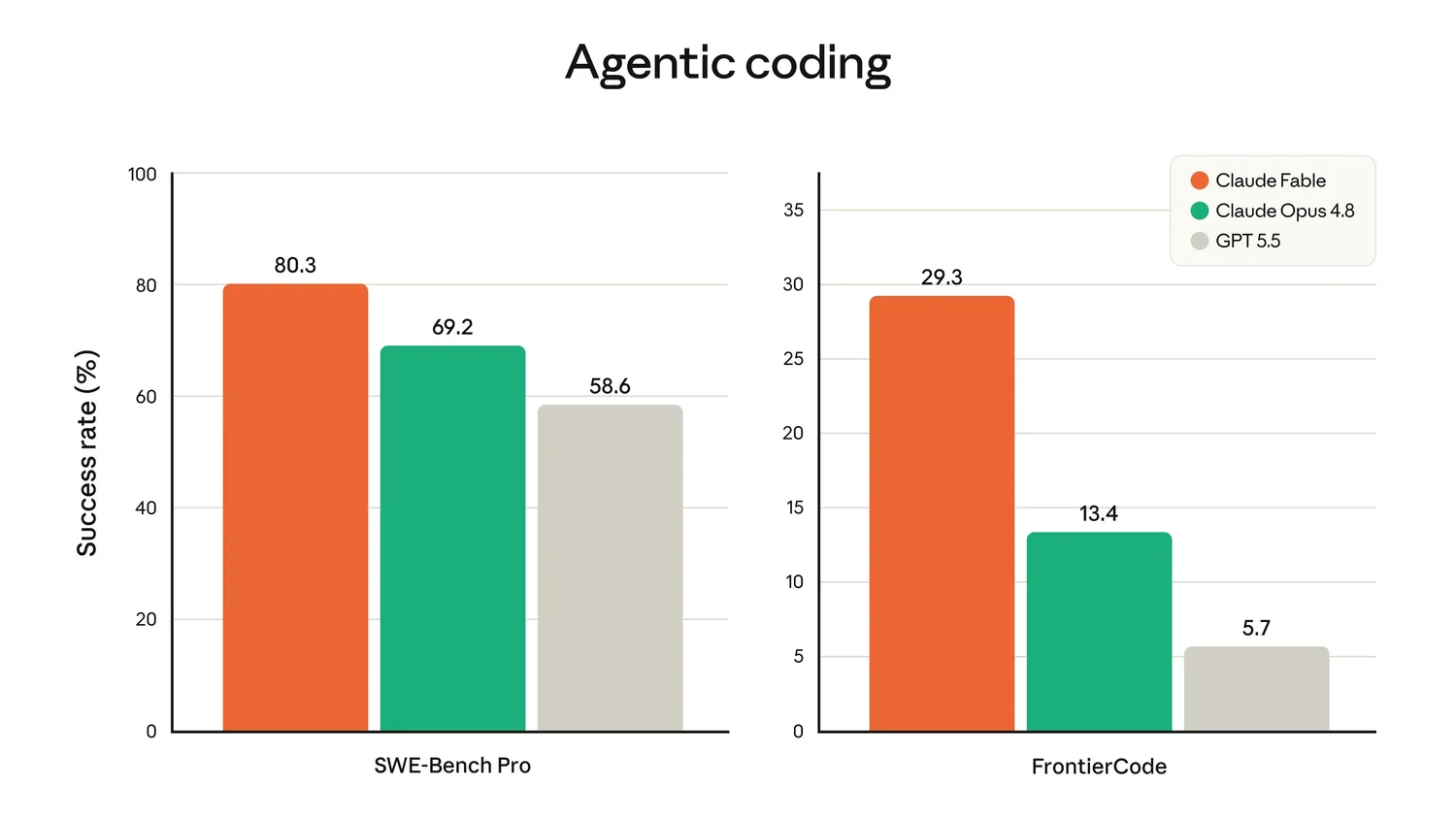
The benchmark figures published by Anthropic paint a clear picture, especially in coding. On the agentic coding benchmark SWE-Bench Pro, the model reaches 80.3 percent, well ahead of Claude Opus 4.8 (69.2 percent), GPT 5.5 (58.6 percent) and Gemini 3.1 Pro (54.2 percent). On the harder FrontierCode (Diamond), the gap is even larger: 29.3 percent versus 13.4 percent for Opus 4.8 and 5.7 percent for GPT 5.5.
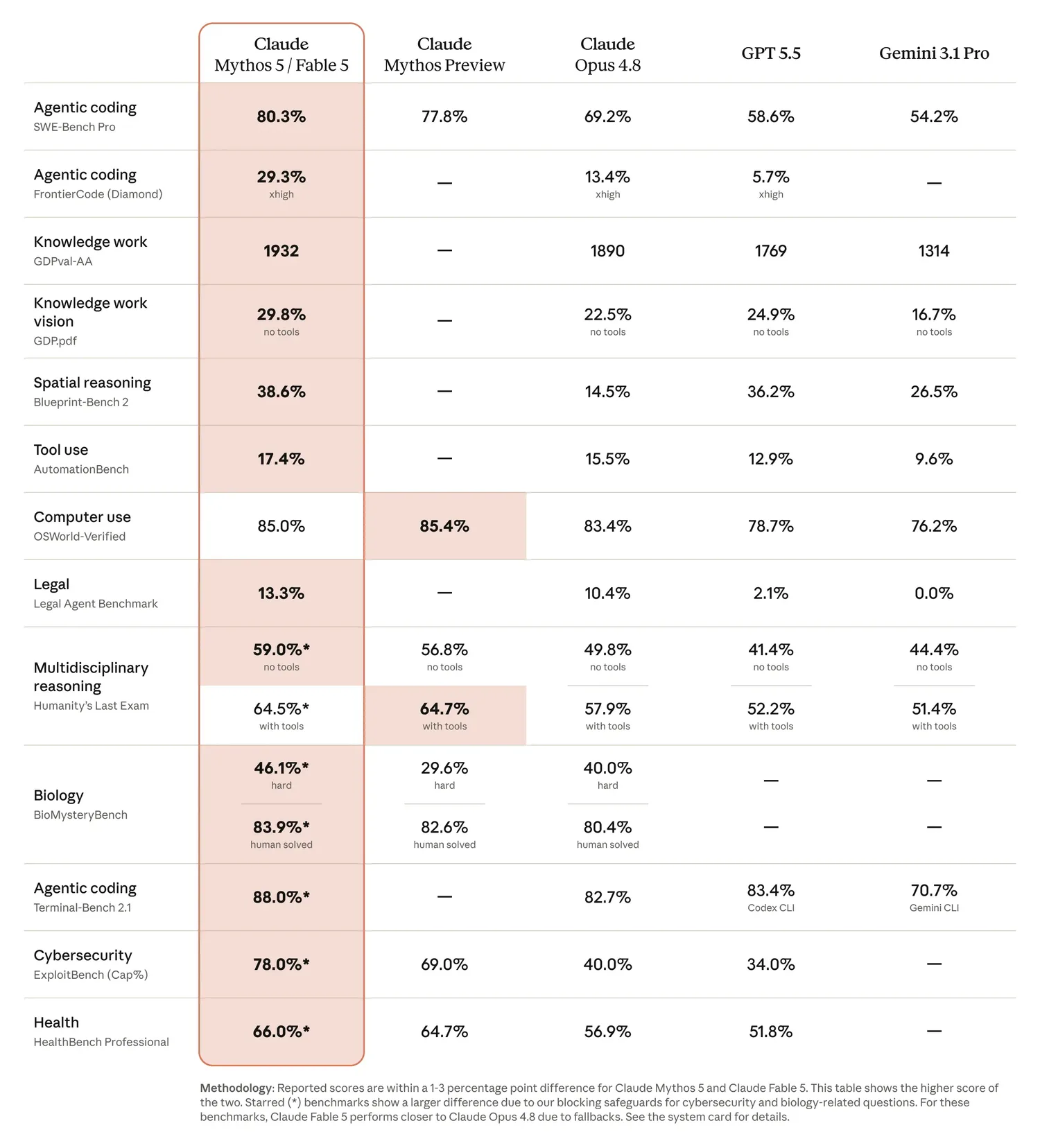
The lead extends well beyond pure coding. A few values from the table:
| Task | Benchmark | Fable 5 | Opus 4.8 | GPT 5.5 |
|---|---|---|---|---|
| Agentic coding | Terminal-Bench 2.1 | 88.0 % | 82.7 % | 83.4 % |
| Knowledge work | GDPval-AA | 1932 | 1890 | 1769 |
| Tool use | AutomationBench | 17.4 % | 15.5 % | 12.9 % |
| Cybersecurity | ExploitBench | 78.0 % | 40.0 % | 34.0 % |
| Health | HealthBench Professional | 66.0 % | 56.9 % | 51.8 % |
Good to know: Anthropic notes that the starred benchmarks (such as cybersecurity and biology) come out lower for Fable 5 than for Mythos 5. The reason is the safety mechanisms: on sensitive questions, fallbacks kick in, so Fable 5 lands closer to Opus 4.8 there. Anyone who wants the full numbers will find them in the Mythos 5 column.
First place in the Code Arena, at twice the price
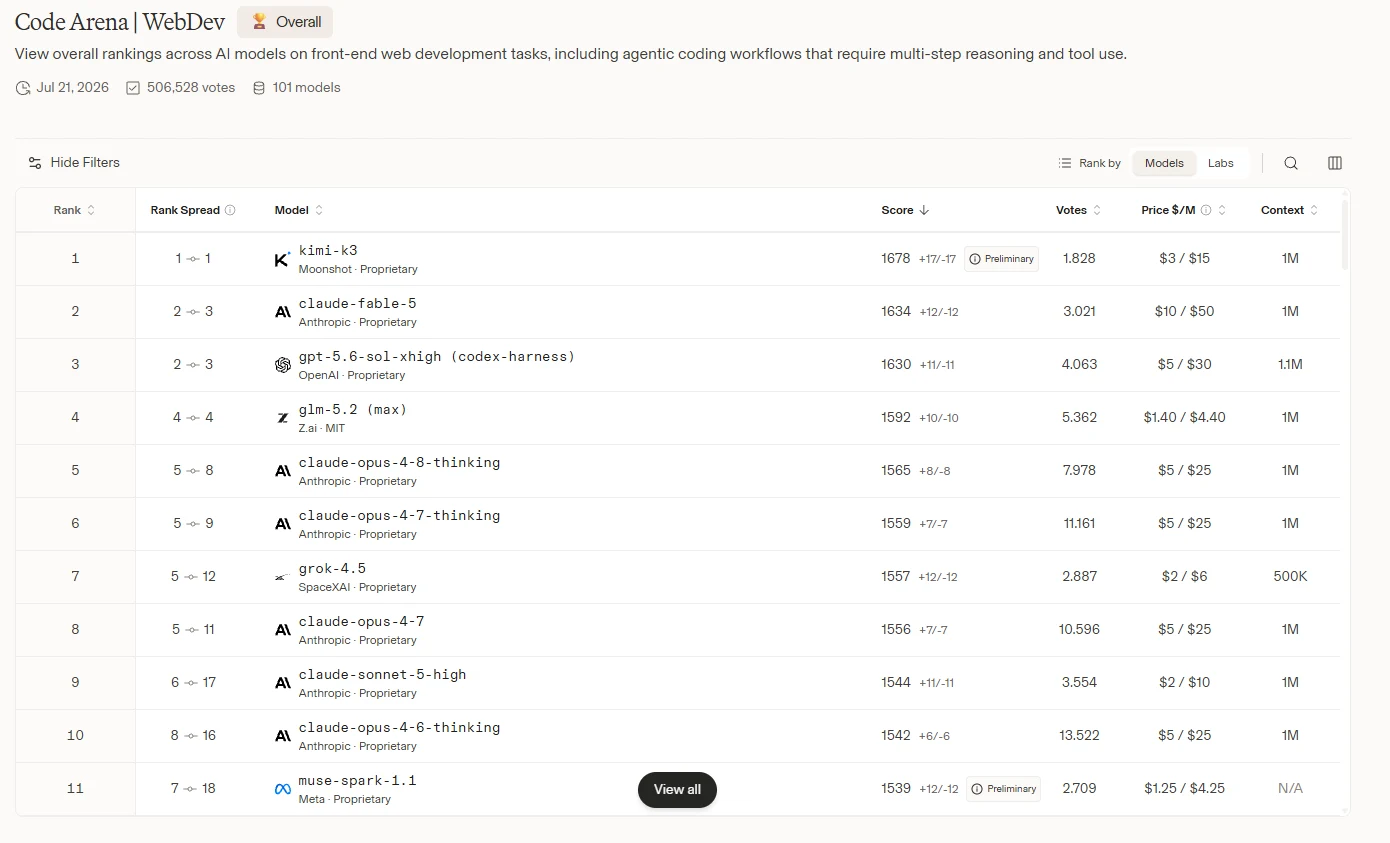
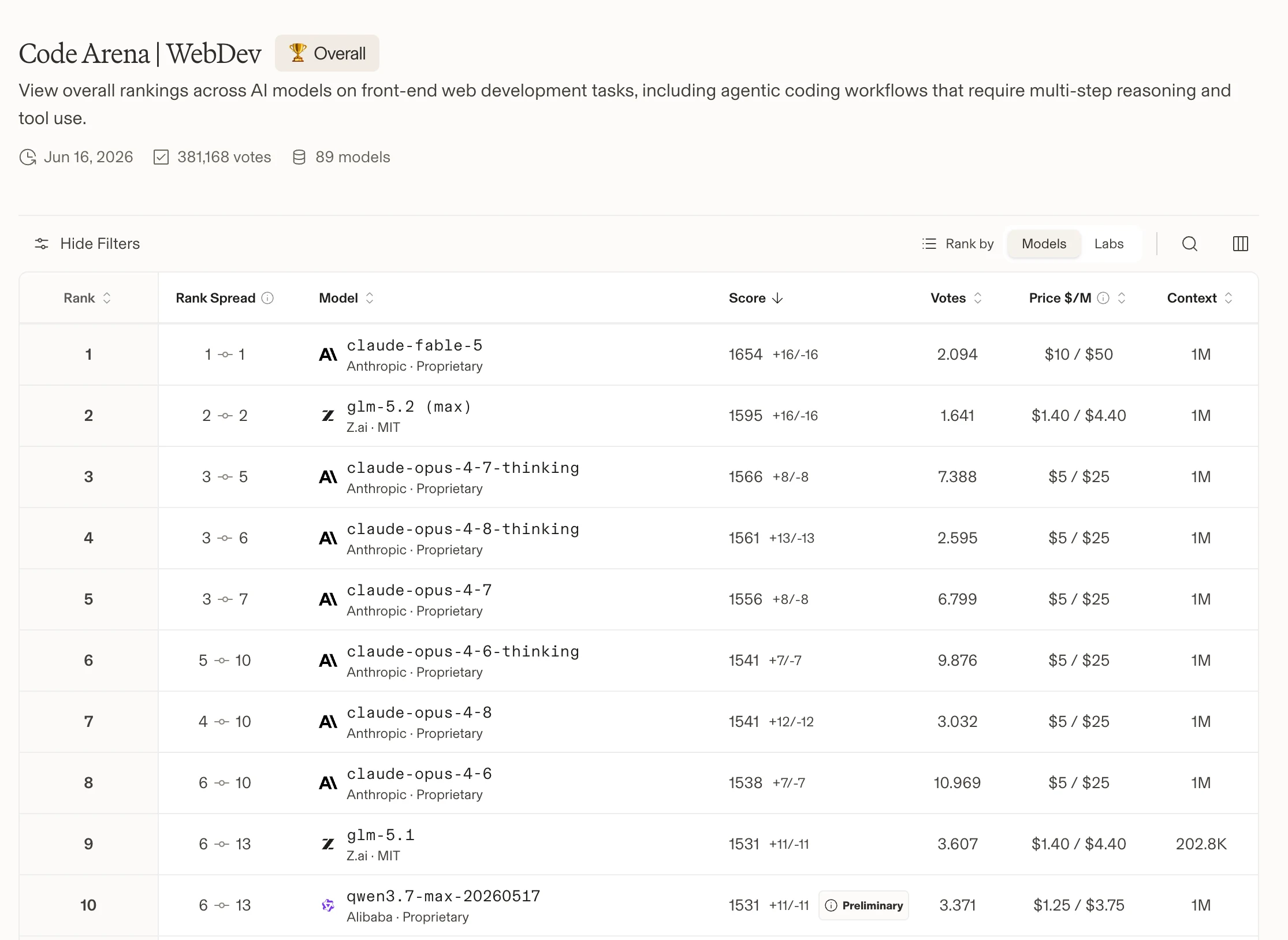
In the Code Arena for web development, Fable 5 sits at number 1 with a score of 1654, a clear margin ahead of the second-placed Claude Opus 4.7 Thinking (1566). Notably, the entire top of the leaderboard consists of Anthropic models.
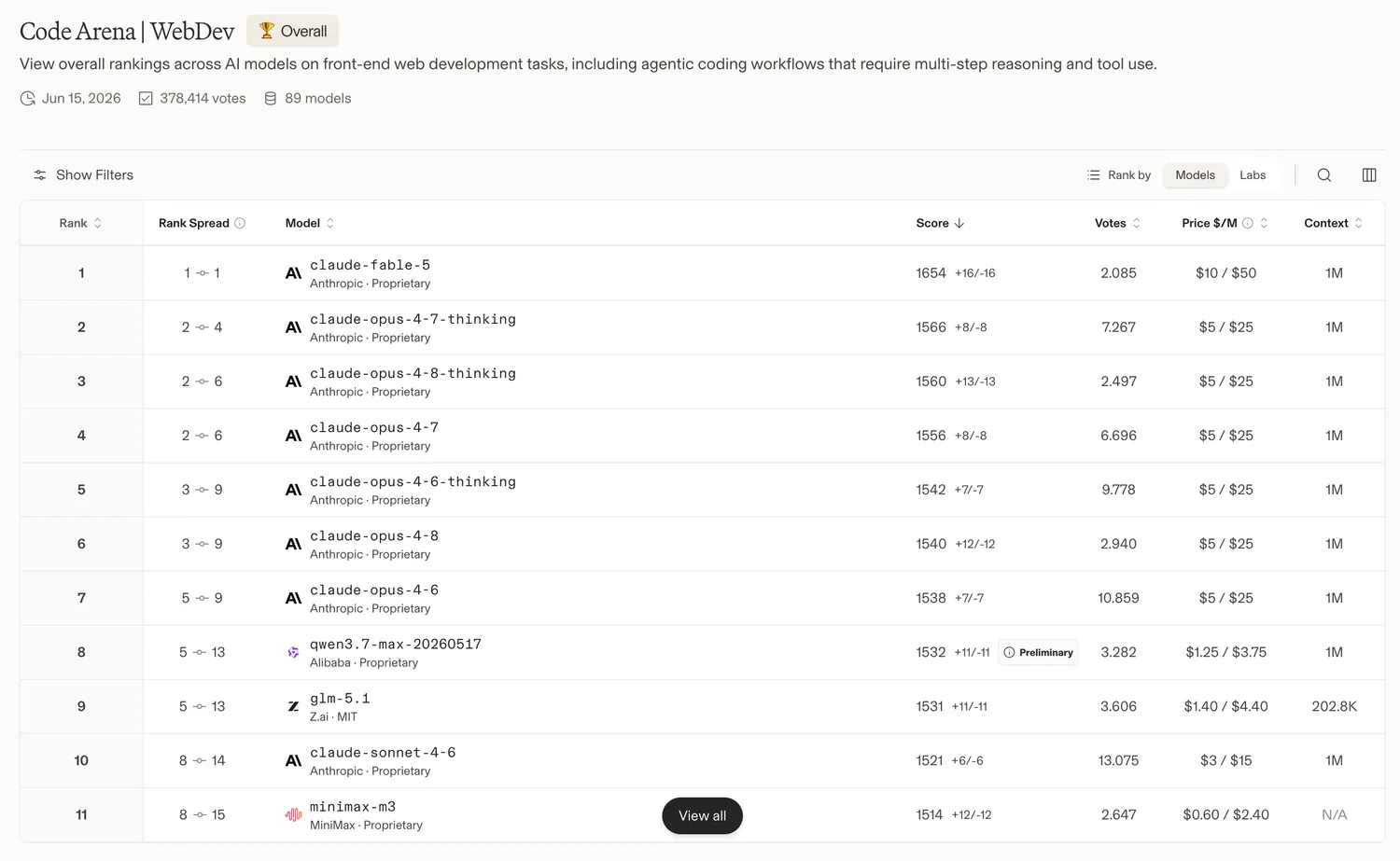
The decisive catch is in the same table, in the price column. Fable 5 costs around 10 US dollars per million input tokens and 50 US dollars per million output tokens. That is exactly double the price of Opus 4.8 (5 and 25 US dollars). The added performance is real, but it comes at a price that becomes noticeable in productive use. This is exactly where our hands-on assessment below comes in.
The announcement video
Anthropic introduced Fable 5 in a dedicated video. It frames the model family and shows the key capabilities at a glance.
Briefly online, then blocked: what might be behind the offline move
A few days after launch, Fable 5 was no longer freely available. The FAZ reported on a block by Anthropic and its consequences, especially for European users. Officially, Anthropic points to safety mechanisms that engage with a model this capable.
As plausible as that sounds, a second look is worthwhile. Anthropic is approaching an IPO, and a model that tops the benchmarks and then disappears again with the label “too powerful for continuous operation” generates exactly the attention a company can use ahead of an IPO.
Our take: The safety rationale and a PR effect do not exclude each other. In our view, the combination of record benchmarks, brief availability and an imminent IPO is at least striking. Deliberately staged scarcity cannot be proven, but it also cannot be ruled out. It changes nothing about how the model itself should be judged, but it does shape how the communication should be read.
Our hands-on test: agentic coding with 15 subagents
Benchmark numbers are one thing, everyday work in the development process is another. Dometrics tested Fable 5 extensively, with a focus on simultaneous agentic coding. The setup: Visual Studio Code with the Claude extension and 15 subagents working in parallel on a real codebase.
The result is twofold:
- Performance and accuracy convince. Fable 5 maintains a high hit rate even across many parallel agents, makes clean decisions and delivers consistent results. On complex, multi-step tasks, the quality advantage over Opus 4.8 was clearly noticeable.
- Token consumption is enormous. The model burns through tokens. Combined with the double price compared to Opus 4.8, a larger agent run gets expensive fast. Running 15 subagents in parallel makes that immediately visible in the cost.
The practical consequence is a question of economics, not capability. For error-critical, demanding tasks where every avoided mistake is more expensive than the extra tokens, Fable 5 justifies its price. For routine work, broad exploration or long, low-stakes runs, Opus 4.8 remains the more economical choice in many cases.
Remember: Fable 5 is not the model for every task, but the model for the hard ones. The right strategy is rarely “everything on Fable 5,” but a deliberate mix: the stronger model where accuracy outweighs cost, and the cheaper one where volume matters.
What this means for companies
The jump in model quality mainly shifts the boundary of what can sensibly be automated. Tasks that were previously too complex for reliable AI support move within reach, from demanding coding to multi-step research and analysis.
What matters is choosing the model per task instead of a blanket “always the best model.” This trade-off between performance and cost is part of the work at Dometrics, for example when building AI-assisted content for visibility in AI answers. What that looks like in practice is covered in the SEO & AI Search service and in the guide Generative Engine Optimization.
Conclusion
Claude Fable 5 is currently Anthropic’s strongest generally available model and clearly leads the coding benchmarks. Our tests confirm the high accuracy, especially in agentic coding with many parallel agents. The price is the flip side: with double the rate of Opus 4.8 and heavy token consumption, productive use gets expensive. The brief availability after launch adds a communicative note that is hard to read entirely without ulterior motives ahead of Anthropic’s upcoming IPO. Anyone who uses the model specifically for the hard tasks and falls back to cheaper alternatives for the rest gets the most out of Fable 5.
Frequently asked questions
What is Claude Fable 5?
Claude Fable 5 is the first model in Anthropic's Claude 5 family and belongs to the new Mythos tier, which sits above Claude Opus. It is Anthropic's most intelligent generally available model, with a context window of one million tokens and a knowledge cutoff of January 2026.
What is the difference between Fable 5 and Mythos 5?
Both share the same underlying model. Fable 5 is generally available and includes additional safety measures for sensitive areas such as cybersecurity and biology. Mythos 5 is the same model without those measures and is only accessible to approved organizations. In benchmarks the two typically differ by 1 to 3 percentage points.
How much does Claude Fable 5 cost?
Fable 5 costs roughly 10 US dollars per million input tokens and 50 US dollars per million output tokens. That is exactly double the price of Claude Opus 4.8 (5 and 25 US dollars). For token-heavy workloads like agentic coding with multiple subagents, this premium adds up quickly.
Why was Claude Fable 5 taken offline temporarily?
According to FAZ reporting, the model was only briefly available after launch and was then blocked again, with consequences especially for European users. Anthropic cites safety mechanisms. Since the company is approaching an IPO, a PR-driven component cannot be ruled out, in our view.
Is Claude Fable 5 worth it for agentic coding?
In Dometrics' tests, Fable 5 delivers very high accuracy and stable results, especially with subagents running in parallel. The catch is token consumption: due to the double price compared to Opus 4.8, usage gets expensive. For complex, error-critical tasks it pays off; for routine work, Opus 4.8 is often more economical.
What context window does Claude Fable 5 have?
Claude Fable 5 processes up to one million tokens of context. This allows large codebases, long document collections or extensive conversation histories to be handled in a single pass.