Contribution margin instead of platform ROAS
Server-Side-Tracking closes the data gaps, and a dashboard brings advertising costs, returns and cost of goods together. Steering is based on profit per order, not on revenue in the ad manager.
Dometrics helps online shops align growth with contribution margin: complete tracking, profitable bidding and customers who come back, instead of expensively bought one-time orders.
Revenue grows, profit doesn't keep pace. That's no accident, but the consequence of decisions made on incomplete numbers.
Advertising costs climb year after year, and margin shrinks with them. More budget brings more revenue, but ever less profit, and at some point the math tips over.
Since iOS 14.5 and cookie restrictions, the ad manager only sees part of the truth. Optimization runs on data that is demonstrably incomplete.
ROAS says nothing about returns, shipping costs and cost of goods. Campaigns can look excellent by revenue and still burn money. Which ones do is impossible to know without a contribution-margin view.
Every new customer is acquired at high cost and never orders again. Without repeat purchases, the first order has to carry the entire acquisition cost, and that is exactly where scaling fails.
Most shops fail not because of bad ads, but because of a calculation no one opens up in full: what’s left per order after advertising costs, returns, shipping and cost of goods are paid? Anyone who doesn’t know this number scales blindly, and the platforms reward blind scaling with rising spend.
Dometrics helps eCommerce brands make this calculation the basis for steering. Only when every campaign is measured against contribution margin does it become clear which growth is real and which was merely bought revenue.
The starting point is an audit of tracking and unit economics: where are Conversions lost, which products carry the margin, which campaigns burn it? From this comes the build order: first the data foundation, then margin-based bidding, then conversion optimization and the retention journeys.
How the modules interact is shown by the Growth Engine. The details on Shopify, CRO and Klaviyo are on the service page eCommerce, and the data foundation is explained by Tracking & Data Analytics.
Five modules, one goal: growth that still turns a profit after advertising costs, returns and cost of goods are deducted.
Server-Side-Tracking closes the data gaps, and a dashboard brings advertising costs, returns and cost of goods together. Steering is based on profit per order, not on revenue in the ad manager.
Google and Meta receive margin-based signals: products with high contribution margin get budget, margin killers are throttled. What pays off is what gets scaled.
Organic rankings for category and product terms, plus presence in AI answers for product research. Every organic purchase lowers the shop's average acquisition cost.
Product page, cart, checkout: systematic optimization of the Conversion Rate, so that expensively acquired traffic turns into more orders. Every percentage point acts directly on the margin.
Klaviyo journeys for welcome, cart abandonment, repeat purchase and winback. Email revenue costs no ad spend and turns one-time buyers into profitable repeat customers.
What matters is less the revenue than the unit behind it: margin, repeat-purchase potential and a product that works. Typically, collaboration starts with shops from the mid six-figure annual revenue range. Whether there is a lever is clarified by the Growth Report based on the real shop data.
It closes the gap that browser restrictions and iOS have torn open. More captured Conversions mean better signals for the algorithms of Google and Meta, and therefore more efficient campaigns at the same budget. In practice, this often makes the difference between profitable and loss.
Yes, as part of conversion optimization: Shopify setup, product pages, the checkout flow and the Klaviyo integration. Details are on the eCommerce service page.
The entry point is the Growth Report at a one-time 490 euros: an analysis of tracking, unit economics and channel mix with a clear yes-or-no recommendation. If no lever is found, the fee is refunded; otherwise it is credited toward the next phase. This is followed by the setup build at a fixed price of 3,900 euros over 90 days; ongoing operations start at 2,400 euros per month with a quarterly commitment.
Yes. Shopify is the most common case, but the system works just as well with Shopware, WooCommerce or a custom shop. What matters is that the data layer, conversion measurement and email integration can be set up cleanly, and that is the case with all common platforms.
Because email is the only channel whose revenue carries no advertising costs. Flows for welcome, cart abandonment, repeat purchase and winback raise customer value, and exactly that value determines how much the shop can pay for a new customer. Without a retention journey, every first order has to carry the entire acquisition cost.
Measurably relevant. In a Verdane survey of more than 6,000 consumers, over half of German AI users said they use AI at least occasionally for online shopping, and a similar share has already bought based on an AI recommendation. Shops whose product data and content are readable for ChatGPT and similar systems get recommended there; everyone else simply does not appear in those answers.
An ads agency optimizes campaigns inside the ad account. Dometrics steers the system behind it: tracking, contribution-margin logic, shop conversion and retention, and only then the campaigns. Better ads on a leaky data foundation only scale the error.
From market conditions and margin to shop CRO and AI product search: the most important levers for profitable growth in DACH eCommerce, in one compact read.
Online retail in the DACH region is growing again. For Austria, the eCommerce study by the Austrian Retail Association (Handelsverband) reports a record of around 12.5 billion euros in distance selling for 2025; roughly 69 percent of the population aged 15 and over shops online, and the online share of retail spending has passed 14 percent for the first time. For Germany, the industry association bevh reports revenue growth of 3.2 percent to 83.1 billion euros for 2025 and expects further growth in 2026. Demand is there, it is merely being redistributed.
It is being redistributed above all by the platforms from Asia: according to industry figures, Temu, Shein and AliExpress reached around 3.7 billion euros in revenue in Germany alone in 2025, up more than 27 percent, and the German Retail Federation calculates that roughly every fifteenth online order now goes to a large Asian platform. A shop that wants to grow in the DACH market does not win this competition on price, but through brand, assortment, service and marketing steered for profitability.
The ROAS in the ad manager answers the wrong question. It measures revenue per advertising euro, not profit: returns, shipping, payment fees and cost of goods do not appear in it. Two campaigns with identical ROAS can therefore perform completely differently, one carries the margin, the other burns it. The steering metric has to be the contribution margin per order, in industry terms POAS, Profit on Ad Spend.
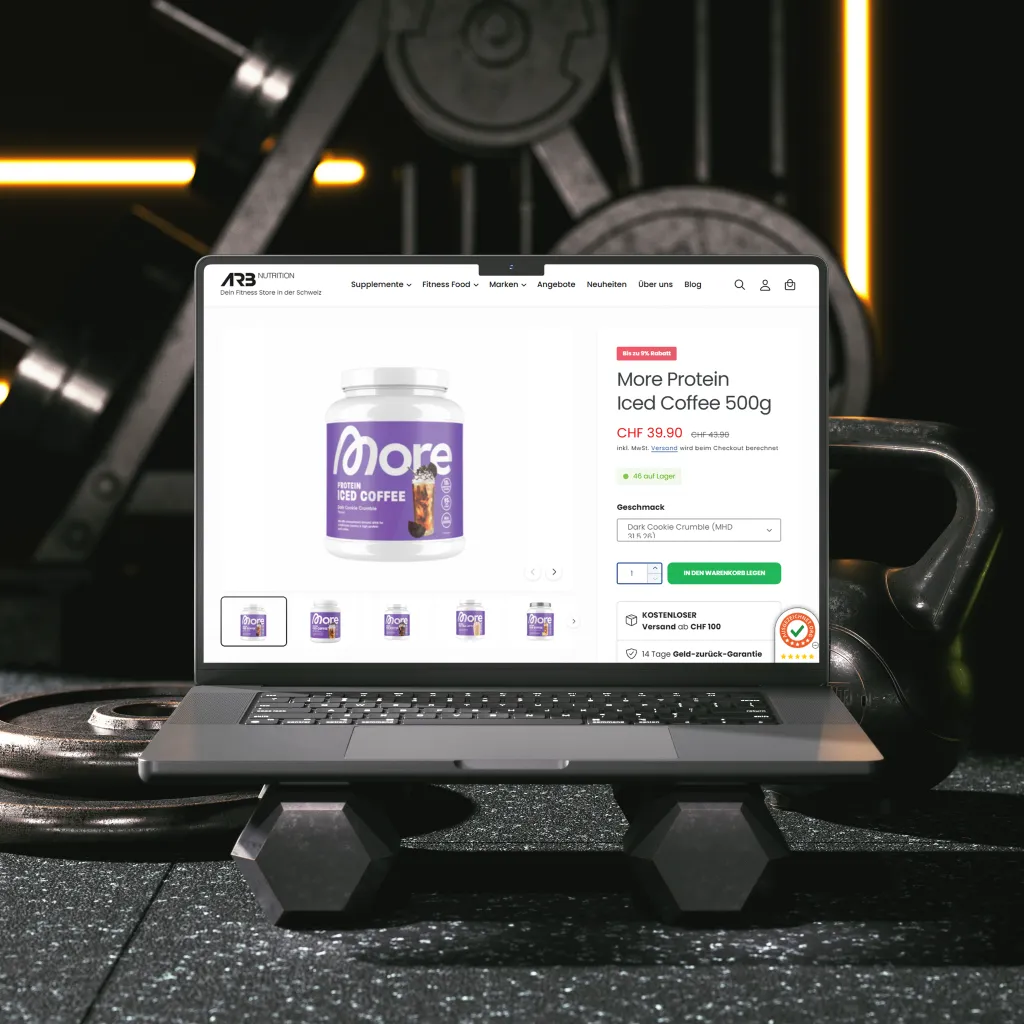
In practice this means: products with high contribution margin receive budget, low-margin items are throttled even if their revenue looks good. How far that carries is shown by the ARB Nutrition case: 24 percent more revenue at a ROAS of 8, built on a dedicated shop system and a cross-channel strategy instead of ever more budget.
On industry average, only around two to three in a hundred shop visitors buy: Dynamic Yield puts the average eCommerce Conversion Rate at about 2.9 percent, Contentsquare most recently at 2.5 percent. Every percentage point above that lowers the acquisition cost per order without a single extra euro of ad budget. That is why scaling starts in the shop itself: product page, cart, checkout.
The gap is largest on mobile: most traffic comes from smartphones, and according to the Austrian Retail Association smartphone spending in Austria grew by 28 percent to 4.1 billion euros in 2025, yet desktop still converts considerably better in benchmarks. A checkout that works on mobile in a few steps is therefore not a detail, it is revenue. The approach is shown in the guide on conversion rate optimization; the implementation in the shop is described on the eCommerce service page.
Category pages are the most valuable pages of a shop: searches like product category plus buy bundle purchase intent, and whoever ranks organically at the top wins orders without a click price. The foundations are a clean site architecture, category copy with substance, fast load times and structured data for products, prices, availability and reviews.
The second effect is often overlooked: every organic purchase lowers the average acquisition cost of the entire shop and makes growth less dependent on rising CPMs. SEO is therefore not a side stage, but the cheapest order source in the channel mix. How Dometrics approaches it is shown on the SEO service page.
Product search is measurably shifting into AI assistants. OpenAI rolled out a dedicated shopping research feature in ChatGPT at the end of 2025, and a Verdane survey of more than 6,000 consumers shows: over half of German AI users use AI at least occasionally for online shopping, and a similar share has already bought based on an AI recommendation. Industry observers expect AI agents to initiate a relevant share of European eCommerce purchases in the coming years.
What gets recommended there is what machines can read: structured product data, well-maintained feeds, citable content on products and categories, consistent data across all directories. Generative Engine Optimization makes a shop visible to these systems before the competitor gets the recommendation. At Dometrics, GEO & AI Search is a dedicated module, not an afterthought of SEO.
Performance Max and Shopping campaigns are only as good as the feed and the signals they are fed with. Product data, titles, images and margin-based values decide which products the algorithm pushes. If Google receives contribution margin instead of revenue as the signal, the campaign scales the products that actually generate profit, as described in the Paid Advertising module.
Meta covers the other half: creating demand instead of merely capturing it, with creatives that sell in the feed. How profitable the interplay can be is shown by the Alpenaquafarm Tirol case: 53 percent more online revenue and a ROAS of 22 on Google, built with high-reach Meta campaigns and search-based Google campaigns for fresh food.
How much a shop can pay for a new customer is decided not by the platform, but by Customer Lifetime Value. If the second and third order arrive reliably, the first one may cost more than the competitor pays, and exactly that is the real scaling advantage. Without repeat purchases, every first order has to carry the entire acquisition cost.
The tool for this is Klaviyo flows: welcome journey, cart abandonment, post-purchase, repeat purchase and winback run automated and cost no ad spend. At UNITED NUDE, automated retention systems raised the share of returning buyers by 30 percent. Which flows to build in which order is shown in the guide on Klaviyo flows for eCommerce.
Since iOS 14.5 and the cookie restrictions of modern browsers, the ad manager only sees part of the actual orders. The algorithms of Google and Meta then optimize on incomplete signals, and every budget decision rests on numbers that demonstrably have holes. Server-Side-Tracking and the Conversions API close this gap: conversions are passed from the shop's own server, stable against browser restrictions and ad blockers.
Dometrics therefore sets up measurement first and brings advertising costs, returns and cost of goods together in one dashboard; only then does budget flow. The technical basics are explained in the guide on server-side tracking, the overall setup on the Tracking & Data Analytics service page.
The system fits shops from the mid six-figure annual revenue range, whether D2C brand, niche retailer or manufacturer with its own online sales. What matters are margin, repeat-purchase potential and a product that works; the shop system is secondary. Brick-and-mortar retailers expanding their online share work with the same foundation.
The entry point is deliberately kept small: the Growth Report analyzes a shop's tracking, unit economics and channel mix and calculates where how much profit potential lies, with a clear yes-or-no recommendation. If no lever is found, the fee is refunded. From Vienna, Dometrics supports online shops across the entire DACH region. Get in touch.
A free initial analysis shows where a marketing budget holds potential and where it does not. Data-based, without obligation, with an honest assessment instead of a sales pitch.
Start the free analysisNo sales pitch, no commitment. Dometrics responds with an honest assessment and says so when there is no leverage to be found.